

Terf island, p.1
Terf Island, page 1


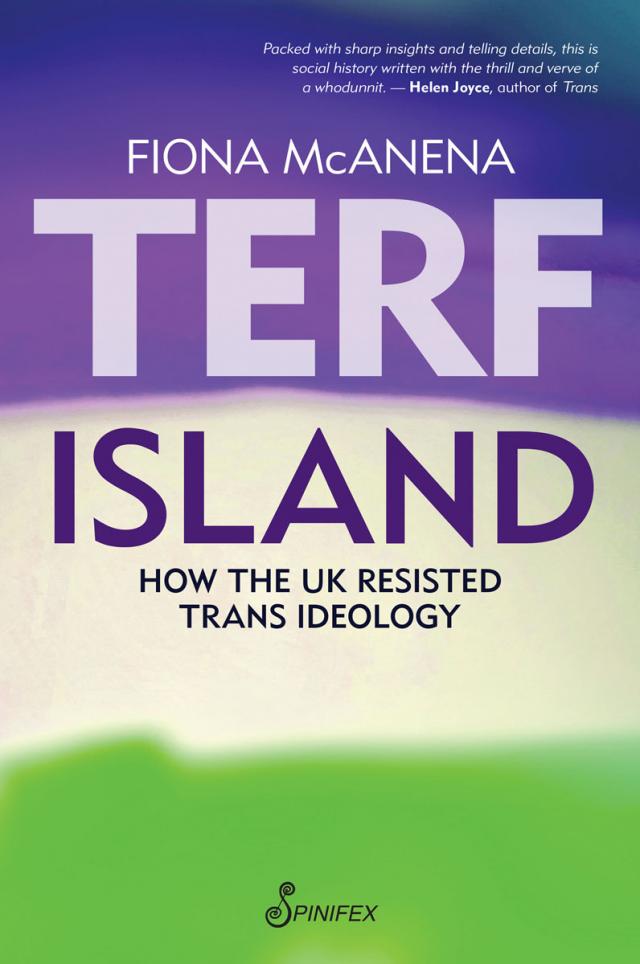
I devoured this essential history of the people and campaigns that turned Britain into Terf Island in a single sitting. Packed with sharp insights and telling details, this is social history written with the thrill and verve of a whodunnit.
—Helen Joyce, author of Trans: Gender Identity and the New Battle for Women’s Rights
When historians chronicle this period of insanity, due honour will go to the four heroic women whose stories are told in this engaging and important book. It’s easy to talk sense now that the tide has turned, but it took real courage in the days when you could lose your job, suffer savage bullying and almost universal ostracism, even physical violence, simply for stating a scientific fact.
—Richard Dawkins FRS, Emeritus Professor of the Public Understanding of Science, University of Oxford
A bracing account of the battle for sanity in a society that fancies itself so modern but has actually gone medieval. The gutsy women in this compelling book have risked everything to defend the reality of unalterable biological sex.
—Lionel Shriver, author of We Need to Talk About Kevin and Mania
A fascinating book about brave key figures in the UK sex-realist movement, told grippingly by another brave key figure. These women deserve to have their stories widely heard.
—Kathleen Stock, author of Material Girls: Why Reality Matters for Feminism
I love this book. It’s calm and authoritative, a reminder of what women can achieve when faced with an overtly misogynist ideology. Anyone who’s heard the phrase ‘toxic on both sides’ should read it, and marvel at the patience and persistence of the inspiring women McAnena has written about.
—Joan Smith, author of Misogynies
History is mostly written by men, about men. This vastly entertaining and informative book is different; about a handful of women whose efforts changed the UK for everyone, including incisive portraits of heroines from Kellie-Jay Keen to Maya Forstater.
—Julie Burchill, journalist, polemicist, novelist; the TV adaptation of her YA novel Sugar Rush won an International Emmy
While much of the world has capitulated to gender identity ideology and its regressive impact on women’s rights, the UK has taken a different path. If you want to know how – and who made that happen – this is the book for you.
—Andrew Doyle, writer and broadcaster, author of The New Puritans and The End of Woke
One day the world will look back on this insane period of biology denial and the wilful mutilation of vulnerable children with true horror. All those in this book from Terf Island can say they did their very best to stop it. Feisty women, every one. I’m proud to be amongst them. Fiona tells the story in brilliant detail of just how hard it was to get facts, science, statistics and even simple respectful debate out into the public domain. All these women are modern day superheroes.
—Sharron Davies MBE, legendary British Olympian, Olympic silver medallist and campaigner
Proud to have been an outspoken Terf Islander although I came to the protest a little later than the women in this book. Defending the rights of women and children was a tough, dangerous and painful battle. These women never gave up. We must all thank them for saving our sex.
—Dame Jenni Murray, writer and broadcaster
Fiona McAnena grew up in Northern Ireland during the Troubles, graduated from Cambridge University, and worked in brand management and marketing strategy in multinational businesses. In 2018, she became concerned at how trans demands were eroding women’s rights and got involved in the resistance. She spent five years as a volunteer with Fair Play For Women, working across its campaigns and directing its successful work in sport. She joined Sex Matters in early 2024 as director of campaigns.
We respectfully acknowledge the wisdom of Aboriginal and Torres Strait Islander peoples and their custodianship of the lands and waterways. The Countries on which Spinifex offices are situated are Djiru, Bunurong and Wurundjeri, Wadawurrung, Gundungarra and Noongar.
First published by Spinifex Press, 2025
Spinifex Press Pty Ltd
PO Box 200, Little River, VIC 3211, Australia
PO Box 105, Mission Beach, QLD 4852, Australia
women@spinifexpress.com.au
www.spinifexpress.com.au
Copyright © Fiona McAnena, 2025
The moral right of the author has been asserted.
All rights reserved. Without limiting the rights under copyright reserved above, no part of this publication may be reproduced, stored in or introduced into a retrieval system, or transmitted, in any form or by any means (electronic, mechanical, photocopying, recording or otherwise) without prior written permission of both the copyright owner and the above publisher of the book.
Copying for educational purposes: Information in this book may be reproduced in whole or part for study or training purposes, subject to acknowledgement of the source and providing no commercial usage or sale of material occurs. Where copies of part or whole of the book are made under part VB of the Copyright Act, the law requires that prescribed procedures be followed. For information contact the Copyright Agency Limited.
No AI Training: Without in any way limiting the author’s [and publisher’s] exclusive rights under copyright, any use of this publication to ‘train’ generative artificial intelligence (AI) technologies to generate text is expressly prohibited. The author reserves all rights to license uses of this work for generative AI training and development of machine learning language models.
Edited by Pauline Hopkins, Renate Klein and Susan Hawthorne
Index by Belinda Nemec
Cover design by Deb Snibson
Typesetting by Helen Christie, Blue Wren Books
Typeset in Arno Pro
Printed and bound in Australia by Pegasus Media & Logistics
ISBN: 9781922964267 (paperback)
ISBN: 9781922964274 (ebook)
For everyone who found their voice,
and for everyone who needs help to find theirs.
Courage calls to courage everywhere.
Each time a woman stands up for herself, without knowing it possibly, without claiming it, she stands up for all women.
—MAYA ANGELOU
Never doubt that a small group of thoughtful, committed citizens can change the world; indeed, it’s the only thing that ever has.
—MARGARET MEAD
CONTENTS
Introduction: Welcome to Terf Island
1 Stephanie Davies-Arai
2 Dr Nicola Williams
3 Kellie-Jay Keen
4 Maya Forstater
5 What Next for Terf Island?
Recommended Reading
Acknowledgements
Index
INTRODUCTION
Welcome to Terf Island
LONG BEFORE TERF ISLAND HAD ITS NAME THERE WERE women who spotted the risks. English journalists Julie Bindel and Suzanne Moore were vilified years ago for writing about it. Julie expressed concerns about transgender ideology and its impact on women’s rights as early as 2004, writing for The Guardian, an English national newspaper with impeccably left-wing credentials. That made her a target for activists, who called her a transphobe and a bigot. A few years later, she was nominated for a Stonewall award for her work promoting gay rights. Yes, that Stonewall, the UK charity promoting equality for gay, lesbian and bisexual people. No mention of trans. Back then, their focus was LGB, without the T. But she didn’t get the award, despite winning the public vote, because of protests by pro-trans activists. Suzanne first got into trouble in 2013 for writing that women were expected to look like “Brazilian transsexuals.”
Feminist academics talked and wrote about the issue too, long before Stonewall even acknowledged it as a cause. Sheila Jeffreys and Julia Long, both lesbian feminist academics, resisted attempts by trans-identifying men to stop them from speaking and to close down their events. Germaine Greer was one of the first women to be cancelled from speaking at a UK university for denying that transwomen are women. “I’m not saying that people should not be allowed to go through that procedure,” she explained in 2015. “All I’m saying is that it doesn’t make them a woman.” Being Germaine, she went much further, saying in a radio interview:
Just because you lop off your dick and then wear a dress doesn’t make you a fucking woman. I’ve asked my doctor to give me long ears and liver spots and I’m going to wear a brown coat but that won’t turn me into a fucking cocker spaniel.
It must have been hard, being one of those early lonely voices and being sanctioned for it. And then what bittersweet relief to see, as the threat grew, a gradual dawning of understanding that there was a problem, and other people finally speaking out.
The work done by the women in this book to draw attention to the UK government’s Gender Recognition Act (GRA) proposals played a big part in the sharp increase in awareness in 2018. It may also have been a big year for transgender publicity, if the pro-trans crowd wanted to normalise trans ahead of their hoped-for change to self-ID in the GRA. The first trigger I remember was the gender-fluid banker, Pips Bunce, who was also a catalyst for Maya Forstater getting into trouble. That was in June before the government’s consultation opened.
Many people have had a hand in the making of Terf Island.1 It would be impossible to give credit to them all, especially since some of them remain anonymous. In this book I track the campaigns, and the women who led them, which created public awareness and mobilised resistance in the UK at that critical time. Without their readiness, it seems likely there would not have been sufficient pushback on self-ID. It may have been passed into law without much public awareness at all, as happened in Ireland.
Instead, a few brave women took on the fight.
The first one I saw was Kellie-Jay Keen on Sky News in autumn 2018. Soon after, I ventured to my first in-person meeting, a Rad Fem 101 event in a church in central London. Both Kellie-Jay and Stephanie Davies-Arai were in the audience. I approached each of them in turn to thank them for what they were doing. Sheila Jeffreys, Julie Bindel and Julia Long were speakers, along with a Scottish woman whose name I didn’t catch. She kept breaking into a half-song half-chant of “she burrrns” which I found quite unnerving. Baby terf that I was, I didn’t get the reference. Terfs2 are evil witches, you see, or their modern incarnation. Linda Bellos and Venice Allan also spoke briefly (see Chapter 3).
A month later, after emailing to offer my time as a volunteer for Fair Play For Women, I met Nicola Williams. Maya Forstater was still in her job then. We didn’t meet until the spring of 2019 when she was asked to give her first talk at a Woman’s Place UK meeting which Nicola and I attended together.
These are the women I saw putting themselves out there when there was no cover. They weren’t the first, but they succeeded in making the issue mainstream, and they did it when it mattered most. Their impact, directly and in encouraging others to join the fight, was monumental. In telling their stories, I have mentioned some others who made important contributions too. There were many more. Other campaign groups have come and gone; new ones have emerged. Scotland has its own groups which started in the critical period from late 2017 to 2018 to fight self-ID laws and which are still fighting important battles. Their stories are told in the important book edited by Susan Dalgety and Lucy Hunter Blackburn, The Women Who Wouldn’t Wheesht (2024).
We can be proud that in this period of women’s rights under attack, when transgender ideology is harming children and vulnerable adults, both straight and gay, we have earned the nickname, ‘Terf Island’. Campaigners around the world look to us in the UK, on Terf Island, for inspiration, courage and hope.
Linda Bellos and Venice Allan at the Rad Fem 101 event in a London church in November 2018
Photo courtesy of Venice Allan
Author’s Note
In researching this book, I have found that memories vary. There have been instances where two people remembered the same events differently. It follows that this account is not perfect. I hope it does justice to the people whose stories it tells.
I have used quoted speech where I am quoting someone’s exact words, usually from my interviews with them. Where I report the gist of what was said but not the precise words, I have reported speech without using quotation marks.
I have quoted Tribunal Tweets’ posts on Maya’s various court hearings. These are real-time posts so cannot be taken as perfectly accurate. I’ve also tidied up a few of them where there were obvious typos.
I’ve referred to Twitter, not X, because that was its name at the time. The habit of calling posts ‘tweets’ is hard to break.
1 ‘In late March 2022, an American journalist wondered on Twitter why the “UK elite” contains more “Terfs” (trans-exclusionary radical feminists) than those of the US or Canada. “The answer is Mumsnet, I believe,” the New York Times columnist Ross Douthat responded.’ As reported in
2 In November 2019, Mr Justice Julian Knowles, in the case of Harry Miller against Humberside Police and the College of Policing, said in the UK High Court, “I have become familiar with the term ‘terf’. It is a derogatory term used by those who seek to de-platform those who hold different views.”
1
Stephanie Davies-Arai
STEPHANIE DAVIES-ARAI RAISED THE ALARM ABOUT THE risks of transgender ideology for children. No one has done more to protect children from the harm of unnecessary medical treatments that claim to change their sex. Her work led ultimately to a court case which was reported worldwide; a major review by the UK’s National Health Service; the closure of the UK’s child gender treatment centre, the Gender Identity Development Service at the Tavistock Clinic in London; and the ending of the use of puberty-blocking drugs on healthy children in the UK in 2024.
As children, Stephanie and her twin Helen were tomboys. They wore clothes from the boys’ catalogue, played football, climbed trees and hated girly stuff. As Stephanie remembers, “We called each other Mike and Bill and we modelled ourselves on Just William. When we were about six, my parents bought us toy prams for our birthday. We turned them into tanks and terrorised the neighbours.”
It’s no surprise that puberty hit them hard. They both developed eating disorders. Stephanie told feminist blogger Lily Maynard:
I grew up in the era of Page 3. Pan’s People were on Top of the Pops. Family entertainment was Benny Hill: older men lusting after schoolgirls and trying to escape their nagging wives. There were strippers in the local pub in Leicester at lunchtime. It was constantly in your face how a woman ‘should’ be. It was only looking back that I realised I’d imbibed all that and I had a deep internal misogyny. I had a real contempt for anything that was feminine.
Maybe they were lucky that they grew up in the punk era, when rejecting femininity was acceptable.
After art college, Stephanie became a successful sculptor. Her sculptures are organic, curvaceous, semi-abstract female forms, ranging from something you could hold in the palm of your hand – and you want to, because they’re so tactile – to life-size pieces cast in bronze or carved in marble. A few years after graduation, a Japanese gallery wanted to buy some of her work, and she decided it would be an adventure to deliver the work herself. She did well in Japan, winning prizes and commissions. She learned to speak and write Japanese. After five years, she came back with a Japanese husband and a six-month-old son, settling in the south of England.
During her pregnancy, the eating issues had faded away. They had three more children. While the children were small, Stephanie co-founded a private primary school, Lewes New School, and was a parent-governor. She volunteered there, supporting the head teacher and working with the children. She studied parenting theory and parent effectiveness training from the USA, but felt it was too child-centred. She believed it should be informed by how children develop, but not led by them – because they are children, with immature brains and limited understanding. As a parent and a school governor, she saw how children perceived and understood things differently, and that meant they couldn’t be put in charge. She saw that children believe what adults tell them, often taking things literally. She developed her own training programme to help Lewes New School teachers and parents to understand this and to communicate more effectively with children.
Word spread and teachers from other schools started asking Stephanie to run training days for them. She also worked one-on-one with parents. Communicating with Kids became a business, Stephanie’s main source of income, and eventually a book which she published in 2015. By then she was amicably divorced, her children were in high school, and she was no longer involved in Lewes New School. Alongside Communicating with Kids, she developed a programme called Communicating with Teens, but by then the transgender issue was starting to take over her working life. Communicating with Teens only ever got one airing before Stephanie parked it indefinitely. She felt there was a more pressing problem to tackle.
As part of Communicating with Kids, she wrote a light-hearted weekly blog about parenting. This led to occasional articles for media sites like the Huffington Post and for Mumsnet. Naturally she read about children too, and around 2013 she started seeing stuff about the idea that children could be transgender. It was usually about a child being ‘born in the wrong body’, and how the parents and sometimes teachers had to adapt to enable this child to be ‘their true self’. The ‘trans child’ was celebrated, with no questioning of what being trans meant, how it had occurred, or what it might mean in the future. Everyone in the child’s life was expected to accept the ‘transgender child’ as truly being the other sex. Siblings were usually in the know, but as far as possible no one else would be told that this was a male child presenting as a girl or vice versa. When a child was socially transitioned very young, before starting school, other children at school were generally not told the child’s real sex. Changing schools was another way that a ‘trans kid’ could start afresh with their new identity.






