

The troupe, p.1
The Troupe, page 1
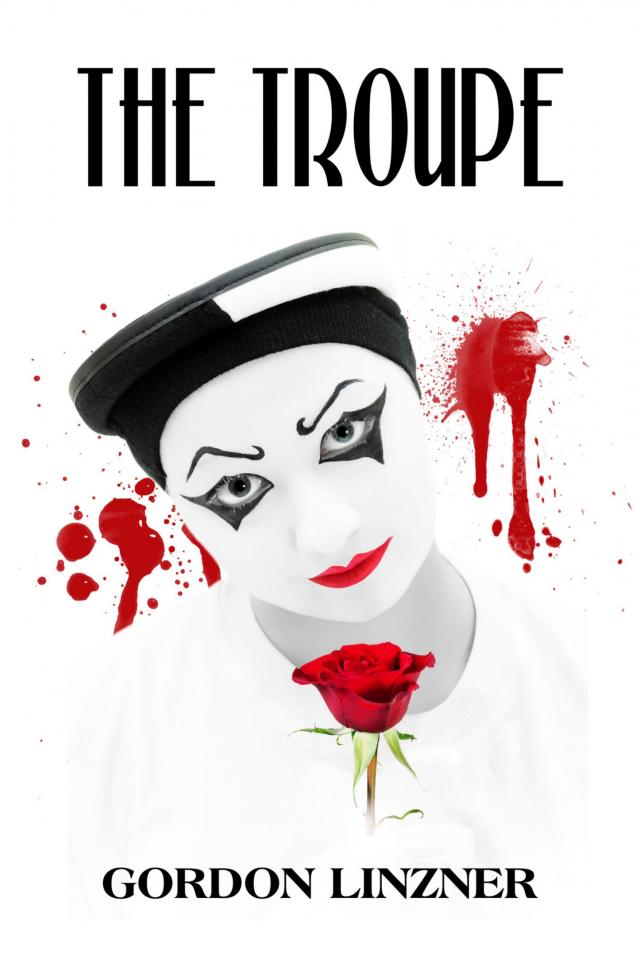


THE TROUPE
By Gordon Linzner
A Macabre Ink Production
Macabre Ink is an imprint of Crossroad Press
Digital Edition published by Crossroad Press
Smashwords edition published at Smashwords by Crossroad Press
Digital Edition Copyright © 2018 Gordon Linzner
Cover design and illustration by Duncan Eagleson
Previous publication by Necon E-books—2011
LICENSE NOTES
This eBook is licensed for your personal enjoyment only. This eBook may not be re-sold or given away to other people. If you would like to share this book with another person, please purchase an additional copy for each person you share it with. If you’re reading this book and did not purchase it, or it was not purchased for your use only, then you should return to the vendor of your choice and purchase your own copy. Thank you for respecting the hard work of this author.
Meet the Author
Gordon Linzner is founder and former editor/publisher of Space and Time Magazine. He is the author of the novels The Spy Who Drank Blood, The Oni, and The Troupe, as well as dozens of short stories appearing in Fantasy & Science Fiction, Twilight Zone, Sherlock Holmes Mystery Magazine, and numerous other magazines and anthologies
DISCOVER CROSSROAD PRESS
Visit us online
Check out our blog and
Subscribe to our Newsletter for the latest Crossroad Press News
Find and follow us on Facebook
Join our group at Goodreads
We hope you enjoy this eBook and will seek out other books published by Crossroad Press. We strive to make our eBooks as free of errors as possible, but on occasion some make it into the final product. If you spot any problems, please contact us at publisher@crossroadpress.com and notify us of what you found. We’ll make the necessary corrections and republish the book. We’ll also ensure you get the updated version of the eBook.
If you’d like to be notified of new Crossroad Press titles when they are published, please send an email to publisher@crossroadpress.com and ask to be added to our mailing list.
If you have a moment, the author would appreciate you taking the time to leave a review for this book at the retailer’s site where you purchased it.
Thank you for your assistance and your support of the authors published by Crossroad Press.
THE TROUPE
Table of Contents
PROLOGUE
PART ONE
Chapter 1
Chapter 2
Chapter 3
Chapter 4
Chapter 5
Chapter 6
Chapter 7
Chapter 8
Chapter 9
Chapter 10
Chapter 11
PART TWO
Chapter 12
Chapter 13
Chapter 14
Chapter 15
Chapter 16
Chapter 17
Chapter 18
Chapter 19
Chapter 20
PART THREE
Chapter 21
Chapter 22
Chapter 23
Chapter 24
Chapter 25
Chapter 26
Chapter 27
Chapter 28
Chapter 29
Chapter 30
Chapter 31
PART FOUR
Chapter 32
Chapter 33
Chapter 34
Chapter 35
Chapter 36
Chapter 37
Chapter 38
Chapter 39
Chapter 40
Chapter 41
Chapter 42
Chapter 43
Chapter 44
Chapter 45
Chapter 46
EPILOGUE
PROLOGUE
With some justice, it is said that New York City’s Times Square never sleeps.
However:
In the final hours before dawn, there is a moment when the crossroads of the world seems to drowse. Suddenly the streets are deserted: the last wino has curled up in a recessed doorway, saving a few drops of dubious brown liquid in the pint bottle nestled in his waistband, against the breakfast jitters; the last hooker, rinsing out her mouth in the stained sink of a cheap hotel room, has decided she’s hustled enough fifty dollar bills for one night, pimp or no pimp; the last chicken hawk is halfway through the Lincoln Tunnel, heading for his cozy retreat in New Jersey suburbia, fingers still atremble with the tactile memory of tender teenage boy-flesh, a well-prepared lie for the wife on his tongue. No cab screeches down Seventh Avenue to beat a changing light; no truck growls clanking past the marble One Times Square building (formerly the Allied Chemical Tower, itself built over the steel framework of the once-impressive Times Tower). On Duffy Square, at Forty-seventh Street, the statues of Father Francis Duffy and George M. Cohan have only each other’s silent company.
A sheet of tabloid newspaper lies flat across the worn white painted line of a pedestrian crosswalk; even the wind is stilled. The underground rumble of the subways here, where half a dozen lines converge—this, too, observes a short-lived lull. There is only the angry buzz of vapor street lamps and neon signs; an arrogant, impatient sound personifying the city’s quietude, aware its supremacy will be brief but secure in the knowledge that the city’s other voices may overwhelm but never wholly dominate.
It is at such a drowsy moment, in the middle of a late-August heat wave, that a tan-and-white, twenty-foot-long Winnebago Phaser Recreation Vehicle turns off Eighth Avenue to move east on Forty-second Street, its hydraulic steering mechanism sighing with the effort. Even though the streets are free of pedestrians and traffic, the vehicle rolls snail-like between two rows of marquees advertising film titles that reek of sweaty sex and violent death:
Claws of Blood
Dirty Sally
Cannibal Isle
Teenage Nymphets
A soft, rhythmic sound comes from the front of the camper—a gloating chuckle issuing from the partly open side window, or merely a loose engine wire? Still the R.V. crawls along, ponderous, deliberate, like a suicidal whale looking for a suitable spot on which to beach itself.
The air brakes expel a long, low hiss, and the Winnebago stops ten feet short of the southwest comer of Seventh Avenue. Another sharp wheeze, and the front door opens out.
The interior is pitch, as if a flat black sheet had been stretched across the inner frame. The sheet quivers. The figure of a man slithers out, boot heels smacking the sidewalk. He pauses, bouncing on the balls of his feet. The glare from the Kentucky Fried Chicken restaurant sign illuminates thick curly hair, swarthy face, and pencil-thin moustache. He smiles, and a gold tooth gleams between slightly parted lips. Perhaps he blinks at the harsh light, but observers, were there any, could not tell; he wears dark glasses with thick earpieces. His knee-length, dark brown leather jacket boasts plenty of pockets, into two of which his hands thrust deep. The jacket is unbuttoned and reveals matching leather pants and a red silk shirt. His Western boots clack sharply as he walks to the subway entrance and down the metal-edged steps … to wait for the proper moment.
The Winnebago pulls away before he sinks from sight.
Neon lights reassert their electric buzz, sounding angrier, begrudging the intrusion on their moment.
The vehicle makes other stops.
At Rockefeller Center a figure dressed in black, with chalk white hands and face, oozes out of the dark cabin to vanish among art-deco shadows.
A broad-brimmed hat obscures the face of one who debarks at Washington Square Park, carrying a folding artist’s easel, who proceeds to huddle beneath the arch.
A box of cheap watches is carried off the R.V. at Wall Street, where the bearer takes a position in the lee of Trinity Church; hand-woven scarves of the finest wool accompany a bald-headed figure, who stretches out on a wooden bench on a leafy median in the center of Broadway, within a few paces of Lincoln Center.
No one sees these five leave the vehicle. Caution is the watchword.
The Winnebago itself is spotted, of course, and more than once, but always in transit. Nothing is thought of it. The early hours are the times Winnebagos travel, after all, to serve as dressing rooms for actors shooting films and television shows on location. What are they filming this time? Who knows? Who cares? So many film crews running around New York these days … and about time the industry returned to the town where it started, too! The streets of Los Angeles pale quickly.
By the time the first pink glow of dawn licks at the tallest high-rises overlooking the East River, the Winnebago has ceased to roam Manhattan’s streets.
Its passengers, however, have not yet begun.
PART ONE
Chapter 1
Benny prowled the lower level of the Port Authority Bus Terminal, a wasted shadow drifting through a fluorescent world. Red-rimmed eyes with wide pupils scanned knots of humanity pushing at the foot of the up escalator, jamming the stairways, and, particularly, pouring through the arrival gates.
The crowds were thinning out. Morning rush hour had peaked while Benny waited for his first shot of the day to hit. Too bad; secretaries and senior clerks were usually good for spare change, being too distracted on the way to work to put up an argument. Tourists, though, could be more generous, if he got to them first.
Benny studied the field calmly, still on his morning high, indulging in the temporary luxury of being selective.
Millions of dollars and man-hours had gone into the renovation of the Port Authority bus terminal, which now sprawled over two full blocks. The result was a greater and noisier rabbit-warren. Every sound echoed from tiled walls, floor, ceiling, columns: tourist chatter, dragged suitcases, baggage carriers in need of oiling, video games pinging away in a comer of the poorly lit sandwich shop. Sight lines were restricted, making it difficult for Benny to spot likely candidates from a distance. Of course, that meant they usually couldn’t see him coming until it was too late to tum aside.
The outside temperature was in the high eighties and seemed likely to reach a hundred by early afternoon. Several homeless senior citizens, three times Benny’s age and more, sought refuge from the killing weather in the air-conditioned waiting rooms. Eventually a guard, spurred on by complaints or zeal or sadism, would chase them out, and then a few more would die of stroke or dehydration. Their ranks never seemed to thin; on the contrary, since the federal cutbacks of funds for social programs there seemed to be more of them every day. Only the faces changed. Benny would pity them, if he hadn’t long ago used up all his pity on himself.
Benny wore a long-sleeved denim jacket and a ratty sweater over his soiled T-shirt, and still he shivered. He was always cold, even when walking on pavement hot enough to fry leather soles. He would die cold, he knew, but at least he wouldn’t wind up like those old folks. He wouldn’t live that long. He might not be alive tomorrow. A junkie had too many ways to die.
For Benny, past and future were equally meaningless. There was only now.
His heavy clothing also served as camouflage. Bruises were invisible against his dark brown skin, but tiny white scars, track marks, scabs, and running sores covered his arms. They could frighten off a mark before he even started his pitch. Then, too, Benny’s thin frame and unprepossessing height worked to his advantage. Apparent youthfulness lent initial credibility to his requests. By the time his mark noticed the grease clumped in his tight-curled hair, the perpetually running nose, and the lack of most of his front teeth, it did not matter whether Benny’s story was true or even plausible. Money was gladly given just to be rid of his embarrassing presence.
Benny leaned against a cool-tiled pillar to watch a group from Philadelphia file through the terminal gate, bringing with them a blast of hot, exhaust-filled air. Near the head of the group marched a pair of teenage girls dressed in matching red shorts and yellow halters. They fiddled with their knapsack straps and looked around with wide eyes and slack mouths. Apparently easy marks: new to the city, easily impressed, incautiously friendly. Benny didn’t recognize either of them, so they might have been just what they appeared to be. Since he was being choosy at the moment, though, he ignored the two, even when they passed near enough that he caught their cinnamon scent. Last month he’d witnessed two separate arrests of pimps by undercover cops similarly dressed, and once he’d seen such a pair board an arriving bus at the foot of the Tenth Avenue ramp, just outside the terminal. They were vice cops, not narcotics, and so weren’t interested in Benny as panhandler or junkie, but if he blew their cover and scared off their real targets they might be pissed enough to kick him around or throw him in a cell overnight.
No, he’d have to be desperate to walk up to a young, sexy female. Sex in itself played no great part in his world: strung out, he found it beyond him; high, he felt beyond it.
Not that Benny was any stranger to desperation. Soon enough he’d start feeling edgy, as the effects of his wake-up shot—the last of his heroin supply—wore off. He knew where to get more; his connection, Nick, was always well stocked, even when every other source dried up. Nick took care of his regular customers … but he never gave credit, and Benny had less than a dollar’s worth of change in his pocket. An addict’s work was never done.
He rubbed a watery eye with a knuckle. The rest of the Philly group looked unpromising, mostly business-suit types around a tight knot of middle-aged women who were obviously, unfortunately, traveling together. Damn. Singly, the latter would have been good prospects; together they had enough peer reinforcement to ignore him.
He had decided to chance intercepting one of the younger business suits when the last passenger stepped through the gate.
She was a large woman, big-boned rather than overweight. Her jawline was strong, and her short-cropped, mousy brown hair contained more than a few gray strands. A leather bag the size of a watermelon was slung over one shoulder; a purse almost as large over the other. Her turquoise blouse was wrinkled from sitting, and the navy blue skirt, pleated and with wide side pockets, reached halfway down her sturdy, unstockinged calves.
She looks like a grandmother, Benny thought. Grandmothers are soft touches.
Still he hesitated. The woman stood a head taller than Benny and weighed at least half again as much. Benny had almost decided to look for the business suit when her head turned toward him.
Their eyes met. She had cold gray eyes, too cold for a grandmother’s; disturbingly compelling. Benny felt drawn by them and pushed himself from the pillar. She turned away, breaking the contact, but too late. Benny was a creature of inertia: once started, he continued to his goal.
“Looking for something, lady? Escalator’s this way. I’ll show you.”
Her soft voice held a rasping edge, as if long disused. “I can see it. Thank you.”
Benny tagged alongside, half running to keep up with the woman’s long stride. “This way, that’s right. There, what’d I tell you? Want me to carry something for you?”
“I can handle my own things, young man. Thank you.”
“Need a cab? There’s a secret to getting a good one. I know the best spot. I’ll hail one for you.”
“No cab.”
“Oh, right. Subway. Know which one? They’re pretty confusing. Where are you headed? I’ll tell you the best way.”
The woman stopped short of the sharp tum to the escalator steps. Benny skidded past, then backtracked under her chillingly opaque gaze.
“You tired, lady? Want to sit down? How about a hamburger? I’m a personal friend of the counterman here.” He jerked a thumb toward the sandwich shop.
“Knock off the bullshit, kid, and go pester someone else. You’re not getting a dime out of me.”
A shiver ran down Benny’s spine that was unrelated to the icy air conditioning. Not your typical grandmother. Benny was too far into his routine to stop now, though.
“Yeah, okay, it’s just that, well, I’m in a sort of a jam.”
“Not interested.”
“Really. My sister’s in Philly, having a baby, and the guy she was living with ran out on her, and I followed him here to get him to come back but he and a couple of his friends beat me up and took my money. I got most of the fare home but I need another dollar seventy-five …”
“You’re wasting your time … and mine.”
“Okay, it doesn’t have to be the whole dollar seventy-five; I mean, even a quarter would be a big help. Even a nickel.”
The woman shook her head.
“Come on, a lousy nickel won’t …”
A heavy hand pressed down on Benny’s shoulder, squeezing hard, spinning him around. He looked up at a familiar, pock-marked man wearing a smoke gray uniform and a grin that was almost too broad for his face.
“How’s it going, Benny? That sister of yours had her kid yet? Been almost a year now. A bit overdue, I’d say.”
Benny winced at the pressure. “Shit, Riley, give me a break. I got a right to earn a buck.”
Riley’s grin did not slacken, but his eyes weren’t smiling. “You’ve got a right to o.d. on arm candy, too. Just don’t do it here, on my shift.”
“Why pick on me? What about those old farts in the waiting rooms?”
“They’ll get their turn. Go work the subway for a while, or the Javits Convention Center.”
“With the security they’ve got? Maybe in another year, when the city’s less smug about their new toy …”
“That’s your problem, Benny. If I see you here again today, you just might lose the rest of those teeth.”
Riley was bluffing. At least, Benny was pretty sure it was a bluff, but he had nothing to gain from calling him on it, and several teeth to lose if he was wrong. He certainly wasn’t going to get anything out of the big-boned woman now.






