

The new makers of modern.., p.1
The New Makers of Modern Strategy, page 1
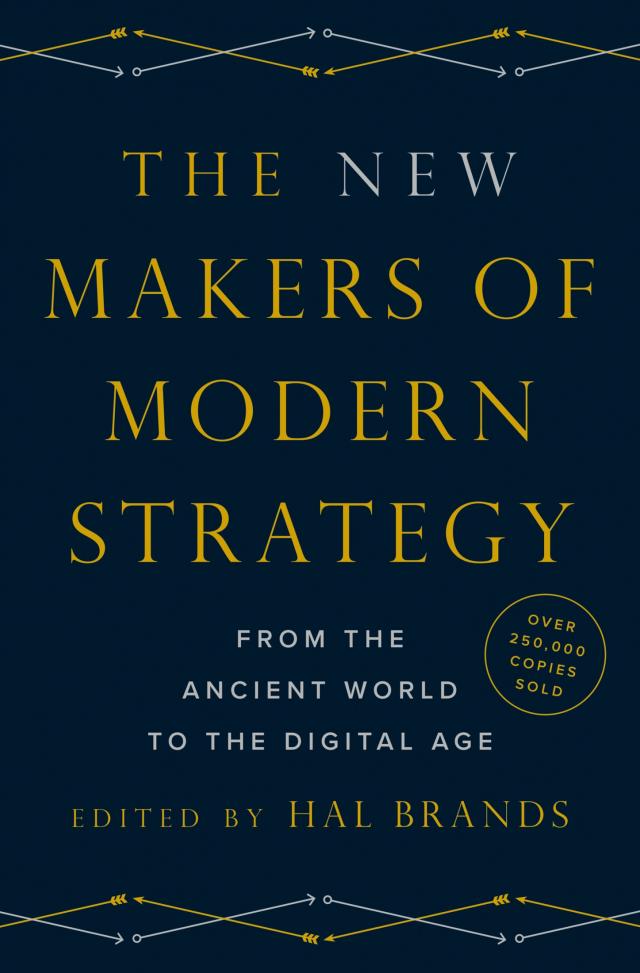


THE NEW MAKERS OF MODERN STRATEGY
THE NEW MAKERS OF MODERN STRATEGY
FROM THE ANCIENT WORLD TO THE DIGITAL AGE
EDITED BY HAL BRANDS
PRINCETON UNIVERSITY PRESS
PRINCETON AND OXFORD
Copyright © 2023 by Princeton University Press
Princeton University Press is committed to the protection of copyright and the intellectual property our authors entrust to us. Copyright promotes the progress and integrity of knowledge. Thank you for supporting free speech and the global exchange of ideas by purchasing an authorized edition of this book. If you wish to reproduce or distribute any part of it in any form, please obtain permission.
Requests for permission to reproduce material from this work should be sent to permissions@press.princeton.edu
Published by Princeton University Press
41 William Street, Princeton, New Jersey 08540
99 Banbury Road, Oxford OX2 6JX
press.princeton.edu
All Rights Reserved
Version 1.1
ISBN 9780691204383
ISBN (e-book) 9780691226729
British Library Cataloging-in-Publication Data is available
Editorial: Eric Crahan and Barbara Shi
Production Editorial: Karen Carter
Text and Jacket/Cover Design: Karl Spurzem
Production: Danielle Amatucci
Publicity: Kate Farquhar-Thomson and Kate Hensley
Copyeditor: Michelle Garceau Hawkins
For Richard Chang
CONTENTS
Acknowledgments xiii
Contributors xv
INTRODUCTION: The Indispensable Art: Three Generations of Makers of Modern Strategy 1
Hal Brands
PART ONE Foundations and Founders 15
1 Strategy: The History of an Idea 17
Lawrence Freedman
2 Thucydides, Polybius, and the Legacies of the Ancient World 41
Walter Russell Mead
3 Sun Zi and the Search for a Timeless Logic of Strategy 67
Toshi Yoshihara
4 Machiavelli and the Naissance of Modern Strategy 91
Matthew Kroenig
5 The Elusive Meaning and Enduring Relevance of Clausewitz 116
Hew Strachan
6 Jomini, Modern War, and Strategy: The Triumph of the Essential 145
Antulio J. Echevarria II
7 Alfred Thayer Mahan and the Strategy of Sea Power 169
John H. Maurer
8 Kant, Paine, and Strategies of Liberal Transformation 193
Michael Cotey Morgan
9 Alexander Hamilton and the Financial Sinews of Strategy 218
James Lacey
10 Economic Foundations of Strategy: Beyond Smith, Hamilton, and List 241
Eric Helleiner and Jonathan Kirshner
PART TWO Strategy in an Age of Great-Power Rivalry 267
11 Sully, Richelieu, and Mazarin: French Strategies of Equilibrium in the Seventeenth Century 269
Iskander Rehman
12 Generational Competition in a Multipolar World: William III and André-Hercule de Fleury 295
Matt J. Schumann
13 Napoleon and the Strategy of the Single Point 319
Michael V. Leggiere
14 John Quincy Adams and the Challenges of a Democratic Strategy 344
Charles Edel
15 Strategic Excellence: Tecumseh and the Shawnee Confederacy 369
Kori Schake
16 Francis Lieber, the Laws of War, and the Origins of the Liberal International Order 391
Wayne Wei-siang Hsieh
17 Japan Caught between Maritime and Continental Imperialism 415
S.C.M. Paine
18 Strategies of Anti-Imperial Resistance: Gandhi, Bhagat Singh, and Fanon 440
Priya Satia
PART THREE Strategy in an Age of Global War 469
19 Strategy, War Plans, and the First World War 471
Margaret MacMillan
20 The Strategy of Decisive War versus the Strategy of Attrition 495
Williamson Murray
21 Strategy and Total War 522
Williamson Murray
22 Woodrow Wilson and the Rise of Modern American Grand Strategy 545
Robert Kagan
23 Democratic Leaders and Strategies of Coalition Warfare: Churchill and Roosevelt in World War II 569
Tami Davis Biddle
24 The Hidden Hand of History: Toynbee and the Search for World Order 593
Andrew Ehrhardt and John Bew
25 Strategies of Geopolitical Revolution: Hitler and Stalin 616
Brendan Simms
26 Mao Zedong and Strategies of Nested War 638
S.C.M. Paine
PART FOUR Strategy in a Bipolar Era 663
27 Nuclear Strategy in Theory and Practice: The Great Divergence 665
Eric S. Edelman
28 The Elusive Nature of Nuclear Strategy 692
Francis J. Gavin
29 Limited War in the Nuclear Age: American Strategy in Korea 717
Daniel Marston
30 Ben-Gurion, Nasser, and Strategy in the Arab-Israeli Conflict 741
Guy Laron
31 Nehru and the Strategy of Non-Alignment 765
Tanvi Madan
32 Lyndon Johnson and Robert McNamara: Theory Over History and Expertise 789
Mark Moyar
33 Strategies of Détente and Competition: Brezhnev and Moscow’s Cold War 817
Sergey Radchenko
34 Arms Competition, Arms Control, and Strategies of Peacetime Competition from Fisher to Reagan 841
Thomas G. Mahnken
PART FIVE Strategy in the Post-Cold War World 867
35 Dilemmas of Dominance: American Strategy from George H.W. Bush to Barack Obama 869
Christopher J. Griffin
36 The Two Marshals: Nikolai Ogarkov, Andrew Marshall, and the Revolution in Military Affairs 895
Dmitry (Dima) Adamsky
37 Strategies of Counterinsurgency and Counter-Terrorism after 9/11 918
Carter Malkasian
38 Strategies of Jihad: From the Prophet Muhammad to Contemporary Times 946
Ahmed S. Hashim
39 Xi Jinping and the Strategy of China’s Restoration 972
Elizabeth Economy
40 Soleimani, Gerasimov, and Strategies of Irregular Warfare 996
Seth G. Jones
41 The Strength of Weakness: The Kim Dynasty and North Korea’s Strategy for Survival 1022
Sue Mi Terry
42 Strategies of Persistent Conflict: Kabila and the Congo Wars 1046
Jason K. Stearns
43 Strategy and Grand Strategy in New Domains 1067
Joshua Rovner
44 A Revolution in Intelligence 1092
Thomas Rid
45 Grammar, Logic, and Grand Strategy 1119
John Lewis Gaddis
Index 1141
ACKNOWLEDGMENTS
The heroes of this volume are the contributors, who put aside important projects to focus on this one, and then put up with the editor’s incessant hectoring along the way. Second only to the contributors themselves are the countless authors whose scholarship has created the intellectual foundation on which this volume rests.
I am grateful also to a number of individuals whose advice and counsel more directly informed the project at various stages of its development: Lawrence Freedman, Michael Horowitz, Will Inboden, Andrew May, Aaron MacLean, Thomas Mahnken, Sally Payne, Erin Simpson, and Hew Strachan, among others. Eliot Cohen deserves a special thanks: he helped conceive this project before other obligations pulled him away from it. Eric Crahan at Princeton University Press first proposed a third edition of Makers and then saw it through to completion, aided by many others at the press. Several research assistants, namely Lucy Bales, Steven Honig, Jacob Paikin, and Jurek Wille helped prepare and format the chapters, as part of a process that Nathaniel Wong oversaw. Chris Crosbie lent invaluable support, as well.
I owe a special debt to a few key institutions. The Johns Hopkins School for Advanced International Studies and the American Enterprise Institute both provided a wonderful intellectual climate. The America in the World Consortium provided valuable financial support. Most importantly, this project simply would not have been possible without the Henry Kissinger Center for Global Affairs and its director, Fra
CONTRIBUTORS
DMITRY ADAMSKY
Dmitry (Dima) Adamsky is a Professor at the School of Government, Diplomacy, and Strategy at Reichman University, Israel. He is the author of The Culture of Military Innovation and of Russian Nuclear Orthodoxy.
JOHN BEW
John Bew is Professor of History and Foreign Policy at the War Studies Department at King’s College London. He became the Prime Minister’s Foreign Policy Advisor in 2019. Bew is the author of five books, the former Kissinger Chair at the Library of Congress, and a winner of the Orwell Prize as well as the Philip Leverhulme Award.
TAMI DAVIS BIDDLE
Tami Davis Biddle retired from the US Army War College as the Elihu Root Chair of Military Studies. She is the author of Rhetoric and Reality in Air Warfare, as well as many articles about the Second World War. She is currently writing Taking Command: The United States at War, 1941–1945.
HAL BRANDS
Hal Brands is the Henry Kissinger Distinguished Professor of Global Affairs at Johns Hopkins University’s School of Advanced International Studies and a senior fellow at the American Enterprise Institute.
ANTULIO J. ECHEVARRIA II
Professor Antulio J. Echevarria II, US Army War College, holds a doctorate from Princeton University and has published extensively on strategic thinking, including War’s Logic: Strategic Thought and the American Way of War (Cambridge 2021).
ELIZABETH ECONOMY
Elizabeth Economy is a Senior Fellow at the Hoover Institution, Stanford University. She is currently on leave to serve as Senior Advisor for China at the Commerce Department. Her most recent book is The World According to China (Polity 2021).
CHARLES EDEL
Charles Edel is the Australia Chair and a Senior Adviser at the Center for Strategic and International Studies. Previously, Dr. Edel served on the US Secretary of State’s Policy Planning Staff. He is the author of Nation Builder: John Quincy Adams and the Grand Strategy of the Republic.
ERIC S. EDELMAN
Eric S. Edelman is Counselor at the Center for Strategic and Budgetary Assessments and a Distinguished Practitioner-in-Residence at Johns Hopkins University’s School of Advanced International Studies.
ANDREW EHRHARDT
Andrew Ehrhardt is a post-doctoral fellow at the Henry Kissinger Center for Global Affairs at the Johns Hopkins University School of Advanced International Studies.
LAWRENCE FREEDMAN
Lawrence Freedman is Emeritus Professor of War Studies, King’s College London. He was appointed Official Historian of the Falklands Campaign in 1997 and served as a member of the official inquiry into Britain and the 2003 Iraq War. He has written on international history, strategic theory, and nuclear weapons issues.
JOHN LEWIS GADDIS
John Lewis Gaddis is Robert A. Lovett Professor of Military and Naval History at Yale University, where he currently teaches courses on grand strategy, biography, and historical methods. His most recent books are George F. Kennan: An American Life (2011) and On Grand Strategy (2018).
FRANCIS J. GAVIN
Francis J. Gavin is the director of the Henry A. Kissinger Center for Global Affairs at the School of Advanced International Studies–The Johns Hopkins University. His writings include Gold, Dollars, and Power; Nuclear Statecraft: History and Strategy in America’s Atomic Age; and Nuclear Weapons and American Grand Strategy, a Choice 2020 Outstanding Academic Title.
CHRISTOPHER J. GRIFFIN
Christopher J. Griffin is a senior program officer at the Smith Richardson Foundation. He previously served as executive director of the Foreign Policy Initiative and on the staff of Senator Joseph I. Lieberman. Griffin is a graduate of Austin College and The Johns Hopkins University School of Advanced International Studies.
AHMED S. HASHIM
Ahmed S. Hashim is Associate Professor of Strategic Studies at Deakin University, School of Humanities and Social Sciences at the Australian Defence College. He specializes in military history and strategic studies with a focus on insurgency and counterinsurgency, conventional wars in the Global South, and Asian defense issues.
ERIC HELLEINER
Eric Helleiner is a Professor in the Department of Political Science at the University of Waterloo. His books include The Neomercantilists: A Global Intellectual History and States and the Reemergence of Global Finance.
WAYNE WEI-SIANG HSIEH
Wayne Wei-siang Hsieh is an Associate Professor of History at the US Naval Academy. He is the author of West Pointers and the Civil War: The Old Army in War and Peace and co-author of A Savage War: A Military History of the Civil War.
SETH G. JONES
Seth G. Jones is senior vice president and Harold Brown Chair at the Center for Strategic and International Studies. He is the author of Three Dangerous Men: Russia, Iran, China, and the Rise of Irregular Warfare and other books. He received his Ph.D. from the University of Chicago.
ROBERT KAGAN
Robert Kagan is a senior fellow at the Brookings Institution. He served in the Department of State and is the author of numerous books and essays on foreign policy and world affairs. He is currently at work on the Dangerous Nation Trilogy, a three-volume history of American foreign policy.
JONATHAN KIRSHNER
Jonathan Kirshner is Professor of Political Science and International Studies at Boston College. His books include An Unwritten Future: Realism and Uncertainty in World Politics and American Power after the Financial Crisis.
MATTHEW KROENIG
Matthew Kroenig is a professor of government at Georgetown University and the Director of the Atlantic Council’s Scowcroft Strategy Initiative. He is fluent in Italian and has taught an annual course on Machiavelli in Florence, Italy, since 2013. His latest book is The Return of Great Power Rivalry.
JAMES LACEY
Dr. James Lacey is the Mathew C. Horner Chair of War studies at Marine Corps University and a professor of Strategic Studies at the Marine Corps War College. He is the author of The Washington War, Gods of War, and Rome: A Strategy for Empire.
GUY LARON
Guy Laron is senior lecturer in international relations, the Hebrew University of Jerusalem, and has been a visiting scholar at the University of Maryland, Northwestern University, and the University of Oxford. He is the author of Origins of the Suez Crisis and The Six Day War.
MICHAEL V. LEGGIERE
Dr. Michael V. Leggiere is Professor of History and Deputy Director of the Military History Center at the University of North Texas. He is the author of several award-winning works on Napoleon’s military campaigns.
MARGARET MACMILLAN
Margaret MacMillan is professor of History at the University of Toronto and emeritus professor of International History at Oxford University. She specializes in the international history of the nineteenth and twentieth centuries and her publications include The War That Ended Peace: The Road to 1914 and War: How Conflict Shaped Us.
TANVI MADAN
Tanvi Madan is a senior fellow and directs the India Project at the Brookings Institution. She is the author of Fateful Triangle: How China Shaped US-India Relations during the Cold War (2020).
THOMAS G. MAHNKEN
Thomas G. Mahnken is a Senior Research Professor at the Philip Merrill Center for Strategic Studies at The Johns Hopkins University School of Advanced International Studies and President and Chief Executive Officer of the Center for Strategic and Budgetary Assessments. He previously taught strategy at the US Naval War College.
CARTER MALKASIAN
Dr. Carter Malkasian is the author of The American War in Afghanistan: A History. Other books include War Comes to Garmser: Thirty Years of Conflict on the Afghan Frontier and Illusions of Victory: The Anbar Awakening and the Islamic State. He is a professor at the Naval Postgraduate School.
DANIEL MARSTON
Daniel Marston is a historian and award-winning author focusing on war and society from the eighteenth to the twenty-first centuries. He is currently Director of the Strategic Thinkers Program at The Johns Hopkins School of Advanced International Studies.
JOHN H. MAURER






