

Gatling 4, p.1
Gatling 4, page 1
part #4 of Gatling Series


The Home of Great
Western Fiction!
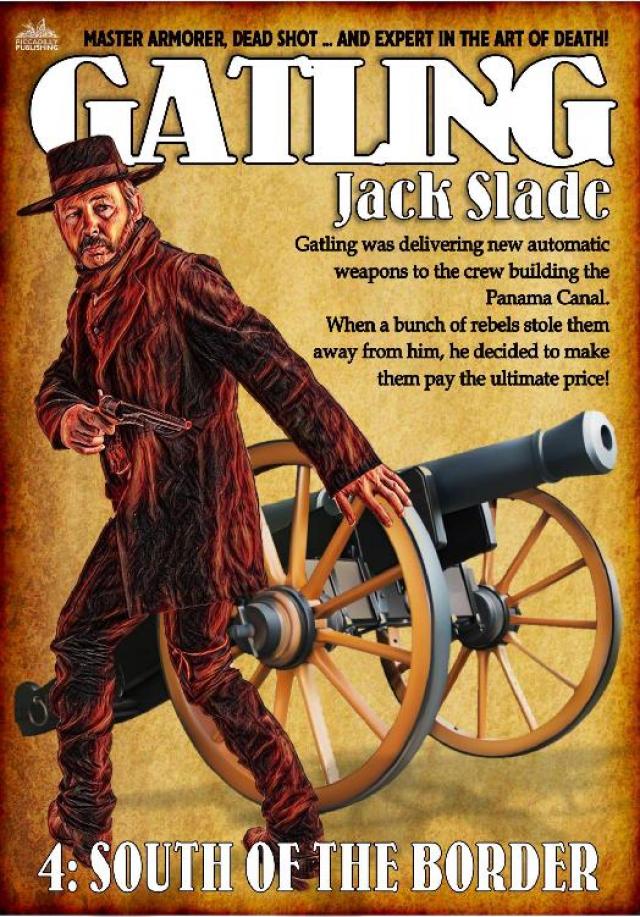
Master armorer, dead shot and expert in death, Gatling tested automatic weapons from all over the world-on living bodies. Paid in gold for his bloody work, he was probably the single most dangerous man in the Old West. For at his command was more firepower than a cavalry regiment and more deadly force than the Grim Reaper. He would need every ounce of skill to take on....
THE MISSION
The U.S. wanted a canal ripped through the jungles of Panama; a host of guerillas, outlaws and renegade politicians wanted the U.S. out. Gatling didn’t care who dug the hole, he just didn’t want to be buried in it. He had work to do. The colonel had entrusted an array of new weapons to him to prove their worth in the field. Using live ammo against live targets was Gatling’s specialty, and in Panama the bullets would be flying thicker than the bloodthirsty mosquitoes.
GATLING 4: SOUTH OF THE BORDER
By Jack Slade
First published by Dorchester Publishing in 1989
Copyright 1989, 2023 by Peter McCurtin
First Electronic Edition: January 2023
Names, characters and incidents in this book are fictional, and any resemblance to actual events, locales, organizations, or persons living or dead is purely coincidental.
All rights reserved. No part of this book may be reproduced or transmitted in any form or by any means, electronic or mechanical, including photocopying, recording or by any information or storage and retrieval system, without the written permission of the author, except where permitted by law.
This is a Piccadilly Publishing Book
Series Editor: David Whitehead
Text © Piccadilly Publishing
Published by Arrangement with the Author Estate.
Table of Contents
Prologue
Chapter One
Chapter Two
Chapter Three
Chapter Four
Chapter Five
Chapter Six
Chapter Seven
Chapter Eight
Chapter Nine
Chapter Ten
Chapter Eleven
Chapter Twelve
Chapter Thirteen
Chapter Fourteen
About the Author
Prologue
THE REBEL LIEUTENANT’S watch was fast or he was in a hurry. It wasn’t sunrise yet, but he came to the adobe house where Gatling was under heavy guard and told him it was time to be shot. The lieutenant looked as if he’d been a clerk or a village schoolteacher before he joined the National Independence Army of Panama. He wore eyeglasses and a mustache and a neatly patched uniform: the kind of man who liked to shuffle and reshuffle papers. He had fooled with papers during Gatling’s trial, over which he’d presided in the absence of higher authority. He’d delivered a number of speeches in the course of which he’d denounced Yankee imperialism and extolled the magnificent qualities of the Panamanian People. The villagers, who’d been forced to witness the trial, had stood silent and uncomprehending until prodded into vigorous applause by the bayonets of the lieutenant’s soldiers.
Worn out by his own oratory, the lieutenant had found Gatling guilty and sentenced him to be shot at sunrise of the following day. Now, attended by a sergeant with his stripes painted on the sleeves of his ragged shirt, the lieutenant read the order of execution in flowery Spanish before he repeated it in a few words of plain English.
“You see we observe the formalities,” he stated. “You have been sentenced to be shot at sunrise, and that is what we do.” The lieutenant drew himself up to his full height of five feet, two inches. “Please not to make any trouble. No priest will be permitted. We are anticlerical: all the priests have been shot.” The lieutenant patted the plain rubber grip of his Remington .44. “I shot the priest who baptized me. It was the least I could do to wash away the stain of his witchcraft.”
Good for you, Gatling thought. Maybe I can return the favor. The true believers were the worst, the revolutionaries who didn’t steal. At his so-called trial, he’d tried to explain that he had come to Panama as a member of an American expedition whose sole purpose was to find the best route for a canal across the Isthmus. The United States had no dark designs on Panamanian territory, he’d said. The expedition had received permission for its work from the Colombian government and the Governor of Panama, Tomas Suarez de Cordoba.
That had been a mistake, not that anything he said would have made any difference. The lieutenant had shouted him down. “Tyrants! Traitors!” he’d shouted. “The Panamanian People need bread, not canals. Canals for your Yankee battleships! Let the Yankees dig that trench. We will bury them in it.”
Now they were marching him out past the end of the village where a tree trunk had been cut down to six feet. Years before, the bark had been stripped and iron fetters driven into the wood. The execution post was pocked and splintered with the bullets of many executions, and the ground around it had been cleared and trampled flat. Behind it the jungle, dark and green, came in close. Birds and monkeys were squawking and chattering in the trees. It wasn’t quite sunrise, but it was steaming hot. Except for the mountains, it was always hot in Panama.
There was even a crudely made coffin for him to be buried in: the prissy lieutenant was observing all the formalities. Usually they dumped you in a shallow grave, and that night the dogs dug you up for a moonlight feast. Gatling figured he wouldn’t need the coffin if the stick of Maximite worked the way it was supposed to. Maximite, the latest invention of Hudson Maxim, brother of the weapons king Hiram Maxim, was fifty percent more powerful than dynamite. The slender stick of Maximite, now tucked inside his shirt collar, was equal to one standard stick of dynamite. The trouble was, they had broken it when they searched his boots. They had found the knife in the lining of his boot, but missed the Maximite. But broken though it was, the fiber that ran through it held it together. It looked like a very thin candle snapped in several places and still joined by the wick. Even if they hadn’t taken his match case, he could not have used it to blow out the wall of the makeshift jail. It was too powerful; he would have been blown to stew meat. And now, getting closer to the execution post, he still didn’t have a match.
Barefoot villagers watched from the edge of the execution ground. That was the law; they had to be there. If they had any interest in the proceedings, it was because this time the condemned man was an American. No one in Panama liked Americans, but to put one in front of a firing squad was most unusual. In color, the villagers ranged from shoe-polish black to jaundice yellow. They looked with longing at Gatling’s clothes and boots, but knew the soldiers had first crack.
The firing squad took up their positions. The sergeant followed Gatling and the lieutenant to the execution post. Only seven men were billeted in the village: the lieutenant, the sergeant, the five soldiers. Not so bad, Gatling thought. He didn’t think the villagers would want to mix in. Revolutions came and went, and they still ate fried monkey meat and bananas. They might be glad to bury the lieutenant and his men.
The execution post was stained with the blood of the enemies of this latest revolution and all the others that had gone before it. After adjusting his eyeglasses, the lieutenant took a folded paper from his pocket, and the sergeant stepped forward to manacle Gatling’s wrists and ankles.
“Don’t I get one last smoke?” Gatling asked before the sergeant could touch him. “A last request ... a civilized man like you ...”
“As you wish,” the lieutenant said. He liked to be thought of as civilized. He was so pleased he reminded Gatling of a monkey pissing on Sunday visitors through the bars of his cage. He took a thin cigar from the shirt pocket and Gatling stuck it in his mouth. The lieutenant lit it with a match he struck on the execution post.
“Ah,” Gatling said, sucking in smoke to make the tip of the cigar burn bright.
“You don’t have to smoke all of it,” the lieutenant said impatiently. Gatling knew the lieutenant intended to smoke the rest of the cigar after the execution was carried out. Some of the soldiers were talking and the lieutenant turned to shout at them.
“Silencio!” he shouted. “Quieto!”
Gatling pulled the stick of Maximite from under his collar and touched off the one-inch fuse, grabbing the lieutenant’s holstered .44 at the same time. He shot the sergeant first because he had a rifle. The lieutenant was no coward and he shouted, “Open fire, open fire!” Gatling shot him in the heart as he tried to grab the gun. Loading levers were clacking. Gatling threw the smoking stick of Maximite at the firing squad, and then ducked behind the post. The stick was light and it fell short, but after it exploded there was nothing left but mangled bodies and a hole in the ground.
For an instant the villagers were paralyzed by their own astonishment, caught like figures in a posed photograph, and then they were gone.
Gatling ran for the jungle ....
Chapter One
“WHY DON’T THEY build the canal across Nicaragua?” Gatling asked. “It’s flatter, has a better climate, a better government, two big lakes that could be joined.”
Colonel Pritchett lay back in his chair and puffed on his pipe. They were in the colonel’s office in the Maxim Company’s warehouse on Crosby Street in New York City. Gatling worked for the Maxim Company, testing its latest weapons under combat conditions.
“Thank you, Professor Gatling,” the colonel said. “I wasn’t aware that you held an engineering degree. But for now the Isthmus of Panama is what it has to be. Yes, I know. DeLesseps has been trying to build a Panama canal for years. Without much to show for it, I might add. Thus far he’s managed to kill twenty thousand workmen, and his company is bankrupt and under investigation for fraud. Bilking the investors, and so on. Now the United States wants to take a crack at it. Good old Britain doesn’t like that, but there isn’t a hell of a lot they can do about it.”
“Then it’s been decided,” Gatling said.
“Good Lord, no,” the colonel said. “Washington never decides anything in haste. The wheels of government are oblong instead of round, producing a sort of stop-and-go motion. But if there is finally a firm decision, my spies tell me it will be Panama. Actually, there are a number of things that make Panama the ideal place for a canal. The Isthmus, at its narrowest point, is only fifty miles wide, and it isn’t quite as threatened by volcanoes and earthquakes as Nicaragua is. While it’s true that the climate—”
“The climate is about the worst in the world,” Gatling said, cutting in. “It rains and steams and stinks. Down there they have yellow fever, malaria, cholera, dengue, galloping consumption. You can take quinine for malaria, but what can you do about yellow fever and cholera?”
“Die, I suppose,” the colonel said.
“They don’t call it the white man’s graveyard for nothing. The mosquitoes and sand flies drive you crazy. In the swamps, along the rivers, they got crocodiles—I’m not talking about alligators—that’ll come right into camp looking for a meal. I’ve been there, Colonel.”
“I keep forgetting that,” the colonel said. “How long was it?”
“A couple of weeks,” Gatling said. “I don’t claim to know the country, but I know what I saw.”
“What were you doing there in the first place?” the colonel asked, as if he didn’t know. “Oh, yes, I remember now. You delivered some Gatling guns to some rebel group, but they didn’t want to pay. You had to kill rather a lot of the poor fellows before their leader came down from the hills and apologized for the misunderstanding. He paid in full, but chased you through the swamps trying to get his money back. Must have been quite exciting.”
Gatling ignored all that. Colonel Harry Pritchett was a genuine son of a bitch, always trying to get the advantage of the other man. Since he’d been kicked out of the British Army for slaughtering two hundred Afghan prisoners—his only son was tortured and killed during the second Afghan War—he’d loved nothing and no one. There were times when Gatling liked the colonel well enough, and there were times when he would gladly have strangled the sarcastic, overbearing bastard. But feelings didn’t have much to do with it; they could do business together, and had.
The colonel continued. “Everything you’ve said about Panama has been said before, all of it bad. Colombia owns the province but can’t control it. We will take it over when the time is right, but we won’t need to go into that. Let’s leave politics to the politicians. What we’re concerned with is finding the right place to dig. Murdock Wheeler will lead the expedition. You know the name?”
Gatling said he did. Everybody who read the newspaper knew who Murdock Wheeler was. A builder of railroads, bridges, and tunnels, he was famous all over the world. At forty, flamboyant and self-serving, he was known as the friend of kings and presidents, and although he was sometimes accused of taking credit for other men’s work, he had the reputation of getting things done. Not the least of his accomplishments was his ability to raise huge sums of money.
“How big is this expedition?” Gatling asked.
“Fifty people so far,” the colonel said. “Surveyors, draftsmen, geologists, engineers. Don’t ask me to sort them out. Two doctors, a photographer and his assistant, one or two newspapermen. Wheeler will be taking along his own cook. All you lesser mortals will have the other cook.”
Gatling wasn’t interested in cooks. “How many soldiers—Marines—whatever they are?”
“Marines. It’s a Navy show,” the colonel said. “Twenty marines. Two lieutenants, eighteen enlisted men. Yes, yes. I realize that’s not nearly enough. Before you start getting hot under the collar, let me point out that no soldiers of any kind will be accompanying this expedition. Officially, that is. Wheeler and Washington had to agree to that or the Colombian government would not have given its permission. These men will not be in uniform, but will be listed on the payroll as laborers.”
“What’s the reason for all this?” Gatling asked. “The first expedition had more than fifty uniformed regulars armed with rifles.”
“Quite correct,” the colonel said. “But that was eighteen years ago and times—and governments—change. This is 1888, and the United States is fast becoming a global sea power, which is the principal reason for wanting a canal which will join the two oceans. The government of Colombia may be made up of thieving half-castes, but they aren’t completely stupid. They don’t want Uncle Sam to turn into a tyrannical father. In short, they smell a rat.”
The colonel liked to hear himself talk.
“Why didn’t they just say no?”
“Money talks,” the colonel said. “Wheeler’s go-between had to cross a few greasy palms with silver. Gold, actually. They like gold. Permission was granted but only if certain conditions were agreed to. One of them was: no soldiers in or out of uniform. We’re breaking our word, of course, but they won’t mind as long as we’re not too flagrant about it.”
“How do I fit into this? The Maxim Company?” Whatever it was, Gatling knew it wouldn’t be on the up and up. But he wasn’t complaining; the weapons business was always a bit shady.
The colonel adjusted his black eyepatch. It gave him one more thing to fool with. He was a man of mannerisms. He filled his foul-smelling pipe like a surgeon preparing to operate. He tugged at his nicotine-stained mustache. And in the last year or so, since he’d lost an eye helping Gatling to fight the Zuni-Apache war in New Mexico, he’d had the eyepatch to fiddle with. He could have afforded the best, most natural-looking glass eye in New York, but he preferred the eyepatch.
“Where do you come in?” the colonel said. “Where you always do. With the automatic weapons, the heavy hardware—and there is the Maxim Company’s newest invention, an explosive called Maximite. In point of fact, it was invented by Mr. Maxim’s brother, Hudson, but we’ll discuss it later. For now, let me assure you that it’s fifty percent more powerful than dynamite.”
“You’re expecting trouble?”
“That’s putting it mildly,” the colonel said. “We must face facts, old man. Some of those Marines are going to die. Microbes, germs, the little beasties that wriggle under the microscope are going to get them. In Panama, the death rate for foreigners is one in three. Some of the civilians will die too, but at the moment that’s not our concern. Our concern is to give this expedition a fighting chance. That means you. You are to be the heavy gun.”
“What if the little beasties lay me low?”
The colonel’s laugh sounded like a rusty hinge. “Come now, you old blackguard, you know you’re too mean to be killed by a microbe. If a fer-de-lance bites you, the snake will die. One look at you and a hungry crocodile will run for bicarbonate of soda.”
“You should join a tent show,” Gatling said. “You could sit on the Fat Lady’s knee and tell jokes. I asked you where the Maxim Company comes into this. It can’t be peddling guns. Is Maxim doing it as a favor to Wheeler? The Navy Department?”
“As a disfavor to Commodore Vanderbilt’s Panama Railway,” the colonel said. “Mr. Maxim wouldn’t share a cup of water with Wheeler in the middle of the Sahara. Thinks him a cad. So do I, if it matters. It all boils down to this: when Mr. Maxim had his first great success with the Maxim .303, he invited the Commodore to some bally great bash he was throwing at his country house in Surrey. The Commodore was in Britain at the time. One captain of industry to another. Except that the Commodore didn’t acknowledge the invitation, and didn’t show up. Not only that, the Commodore had some rather nasty things he said about Mr. Maxim. I think he referred to Mr. Maxim as ‘this rustic mechanic.’”
“Then it’s just spite,” Gatling said.
“Not entirely. This canal will be the greatest engineering feat since the pyramids and the Brooklyn Bridge. Much more important than the Suez, I think, and much more profitable. The Panama Railway was fine in its day, and still serves a useful purpose, but after all, you can’t put a battleship on a flatcar. But there’s no money in battleships except for those who build them. Mr. Maxim owns fifty-one percent of the shipping line. He has a financial interest, yes. Needless to say, the railway johnnies don’t want a canal.”






