

Sundance 28, p.1
Sundance 28, page 1
part #28 of Sundance Series


The Home of Great
Western Fiction
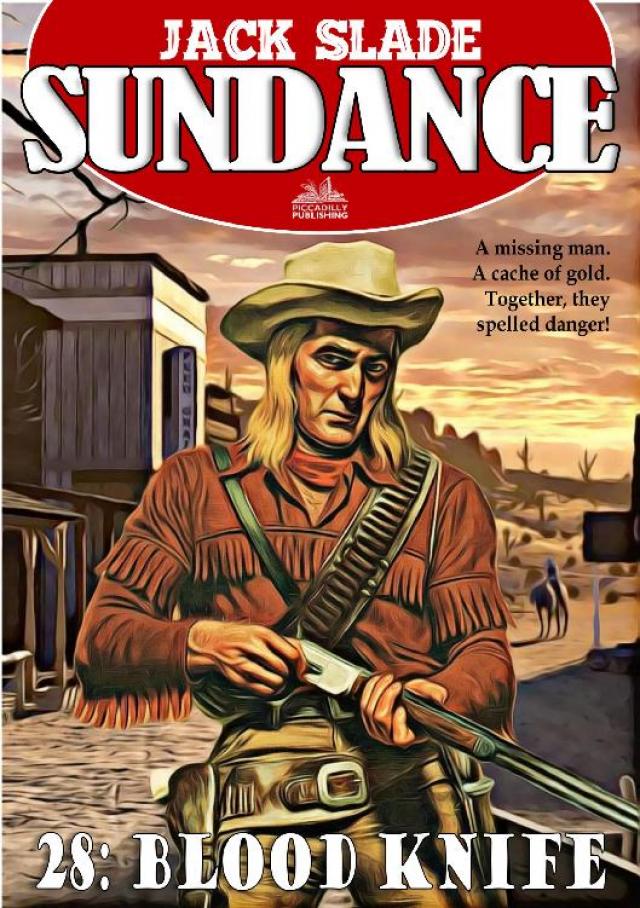
Burke Hunter, one of the deadliest knife fighters in the West, had disappeared.
Sundance was hired to look for him, and got as far as an Apache Indian camp where Hunter had been taken prisoner, suspected of stealing a sacred cache of Apache gold.
But when Hunter double-crossed him and the Apaches tried to capture him, Sundance knew that there was going to be death on the desert, either by a bullet or a blade.
He also knew that Hunter’s beautiful wife Eloise would welcome the survivor, whichever man it proved to be!
SUNDANCE 28: BLOOD KNIFE
By Jack Slade
First published by Norden Publications in 1979
Copyright © 1979, 2023 by Jack Slade
This electronic edition published January 2023
Names, characters and incidents in this book are fictional, and any resemblance to actual events, locales, organizations, or persons living or dead is purely coincidental.
You may not copy, store, distribute, transmit, reproduce or otherwise make available this publication (or any part of it) in any form, or by means (electronic, digital, optical, photocopying, recording or otherwise), without the prior written permission of the publisher. Any person who does any unauthorized act in relation to this publication may be liable to criminal prosecution and civil claims for damages.
This is a Piccadilly Publishing Book
Text © Piccadilly Publishing
Editor: Ben Bridges
Published by Arrangement with the Golden West Literary Agency.
Visit www.piccadillypublishing.org to read more about our books.
Table of Contents
Chapter One
Chapter Two
Chapter Three
Chapter Four
Chapter Five
Chapter Six
Chapter Seven
Chapter Eight
Chapter Nine
Chapter Ten
Chapter Eleven
Chapter Twelve
Chapter Thirteen
Chapter Fourteen
Chapter Fifteen
Chapter Sixteen
Chapter Seventeen
Chapter Eighteen
About the Author
Chapter One
TWO MEN REPAIRING a wall partially ruined by Apache fire arrows heard hoofbeats on the freight road and turned to look at the rider on a tall appaloosa.
One of the men, gaunt and suddenly pale, dropped his hammer and reached for a rifle. His companion said hurriedly, “That ain’t no ’Pache. It’s Jim Sundance, sure as hell.”
His voice reached a tall, black-haired young man with the sharp features of the Indian. He was trying awkwardly to empty a pail of water off the veranda of a squat saloon. His white man’s hat, the crown uncreased, rode like a gray dome atop his head. He stood with the thumb of his right hand hooked in his belt not as an affectation, but to anchor a nearly useless right arm.
Sundance approached the saloon on the great Nez Percé war horse Eagle, spring sunlight touching his weathered sombrero, red neckerchief, and fringed buckskin shirt. Long yellow hair brushed his shoulders.
“Eddie Strong,” Sundance called as the young Cheyenne started for the side of the saloon, limping on the right leg. “Heard you were over here, Eddie. Rode twenty miles out of my way to make sure.” Sundance dismounted, standing tall in the moccasins he always wore instead of boots. He caught the young Cheyenne before he could get away and clasped the left hand in greeting, trying to hide the rage that sight of the ruined young man always kindled in him. “Finally caught up with you,” Sundance said.
“You think you can talk me into going home,” Strong said in Cheyenne, because the two carpenters at the stable next door were staring.
“One reason I’m here, Eddie, is for you to tell me about Burke Hunter. I may have found him at last.”
“Why do you think I stay here in Arizona? Why do you think I came this far south in the first place? Him!”
“Describe Hunter. Everything you can remember about him.”
“I told you. Two years ago. When it happened.” Eddie, known as Two Clouds in the Cheyenne nation, looked bitterly at his right arm. “When I find him, I’ll cut him worse than he cut me.”
“No. Your father was my friend, like a father after mine was killed.” Sundance spoke urgently, black eyes boring into the young man’s face. “I’m the same as your guardian. You’re to go back to our people.”
“I’ve got a job here.” Eddie Strong started away, limping badly.
Sundance halted him and jerked a thumb disdainfully at the squat saloon Eddie Strong was about to enter. “Swamping in a saloon is no job for a Cheyenne warrior.”
“With this bad wing of mine and my leg, you call me a warrior?” Strong said bitterly.
“You can learn to shoot a rifle left handed. I told you that two years ago. You got away from me then. Not again, Eddie.”
“Shoot what, Jim? White men? The buffalo are going fast.”
“The buffalo will last,” Jim Sundance said, mouth in coppery features tightening despite his attempt to sound convincing. Secretly he was not at all sure the Indian’s main food supply, the buffalo, would survive the ambitions of those who sought to build their own empire on the ashes of the red man’s. The scorched wall of the stable next door was a reminder. Weeks ago Apaches had attempted to burn it down along with the four other buildings in the town. The territory seethed since a massacre of Apache women and children by whites. It was not a year to try and rescue a white man being held prisoner by Apaches, yet Jim Sundance might try. He hadn’t quite decided. Money was a consideration. In this case vengeance was more important. It depended on what he learned from Eddie Strong.
“Last time I was north I saw your chief,” Sundance said. “I told him not to blame you because of what happened. You left the tribe because you wanted to try your wings. You got hurt by three unknown white men. In a knife fight.”
“There was only one white man,” Eddie Strong said bitterly. “I couldn’t even handle one man. Let alone three.”
“Sounds better the way I told it to your chief.”
“What difference does it make?” Strong demanded.
“Because if I gave him the name of the bastard who lured you into a knife fight and then crippled you the Cheyennes might take his trail.” Sundance stared into the young man’s eyes. “This one I want for myself, this Burke Hunter.”
Eddie Strong shook his head, braided hair swinging out from beneath the high-domed sombrero. “He’s here in Arizona. A freighter in Kansas told me he heard of a man here named Burke Hunter.”
Sundance interrupted, stressing the realities of life on the frontier. Even if he bested a white man in a fair fight, the gallows would probably be his reward. An Indian kill a white man and go unpunished? Unthinkable.
Eddie Strong this year seemed more inclined to listen to reason than he had two years before in Newton, Kansas. He was tired, constantly harassed by whites. Sundance finally got him to describe in detail his assailant in the knife fight. A man who, instead of backing off in victory, had deliberately severed tendons in right arm and leg.
Sundance listened gravely to Eddie Strong’s emotion-packed voice describe his tragedy. “I want to be sure he’s the Burke Hunter I’m looking for.”
“Jim, you do know where he is.” Eddie Strong seemed spent. “I’ll fight him left-handed, damn it. All I want is another chance. I was a kid then. I’m smarter now. I can handle him.”
“I’ll handle him. You’re going back to our people.”
“Where is he, Jim? Tell me.”
“Seems the Apaches have got him.”
Eddie Strong looked surprised, then burst out laughing. “A prisoner? Of Apaches?”
“So they say.”
Strong continued his almost hysterical laughter, drawing several men to saloon window and doors.
Then the young man was grim, no longer laughing. “I hope they give him the thousand cuts.”
“An easy death compared to some they can give.”
Eddie Strong looked intently at Sundance. “You going after him ... in an Apache camp?” He sounded incredulous.
“If I find out for sure he’s the same Burke Hunter who cut you.”
“If he is,” Eddie Strong interrupted quickly, “don’t let him try and get you in a knife fight like he did me.”
Sundance smiled coldly, letting his hand fall to the sheathed Bowie knife at his belt. “I’ll try and remember your warning, Eddie.”
“Jim, I mean it. I talked big a minute ago, but Hunter can cut you quicker than you can blink. Between the two of us we can handle him.”
Sundance shook his head. “I want your promise to go home.”
It took more argument but finally Sundance prevailed. Strong gave his word, a sacred bond to an Indian, never given lightly.
“You got wages coming, Eddie?”
“Some,” Eddie hedged.
“What do you mean, some?”
Eddie Strong seemed embarrassed to tell how a drunk had given him a shove. “My bad leg buckled and I fell over my bucket and the mop handle went through a side window. Hearne says I have to pay for it. But I don’t know how much.”
“Eddie, you get ready to travel.”
Sundance entered the saloon. Some men had been staring out the window at the Appaloosa, Eagle, the Henry rifle in a saddle scabbard, a bedroll, and two bags made of buffalo hide. These contained weapons more primitive but as lethal in the deadly life game Sundance had chosen to play, when the Cheyenne blood in his veins prevailed over the white. Now the men turned to stare at Sundance’s tall figure, awed by the golden hair in contrast to Cheyenne features. Of special interest was the Colt with ivory grips riding at his hip.
Hearne, a beefy, red-faced man, stared across his bar at Sundance and said roughly, “I don’t sell whiskey to Indians. Not even to breeds.”
“The whiskey you likely sell in a place like this I wouldn’t feed to a snake.”
Patrons gasped, some moving quickly away. Hearne reddened, started to splutter, but Sundance told him why he was here. “I want Eddie Strong’s wages due.”
“I don’t pay till the first of the month.”
“He’s going back to his people.”
Hearne laughed, winked at some of those nearby. “If he’s quittin’, he gets no pay.”
“I want every cent due him. And don’t take out for that broken window. It wasn’t his fault.”
“You givin’ me orders?” Hearne roared. “In me own saloon!”
One of the patrons shouted a warning. “Better go easy, Fred! That’s Jim Sundance!”
“No goddam half breed’s gonna tell me ...” Hearne was reaching for a sawed-off shotgun under the bar when he found himself staring at the cold metal eye of the Colt Sundance had swiftly drawn. He licked his lips, then looked at the man who had shouted the warning. “You ...you said Jim Sundance?” Hearne swallowed and turned back to Sundance. “I hear you take scalps. An’ I sure don’t figure to have mine hangin’ at your belt.”
“No scalps. Just the money you owe Eddie Strong.”
Sundance reached across the bar with his left hand, and with the dozen or so stunned patrons looking on, he took the shotgun from Hearne’s moist fingers. Only then did Sundance holster the Colt. He unloaded the shotgun, dropped the shells into a spittoon, then placed the shotgun on the bar.
Sundance watched carefully as Hearne, trembling slightly, placed several coins on the bar top. Sundance scooped them up, turned and warned the onlookers with his eyes, then walked out.
As the swing doors flapped at his back it seemed that everyone inside, including Hearne, gave an audible sigh of relief.
Sundance rode north five miles with Eddie Strong to make sure Hearne hadn’t decided, with the help of friends, to try and get his money back.
He shook Eddie Strong’s left hand and wished him well on his return to the Cheyennes.
“If you run into Burke Hunter,” the younger man said in parting, “give him a lick for me.”
“If he turns out to be the same Burke Hunter, he’ll get more than that.”
That evening in camp, Sundance reread Eloise Hunter’s letter, which included directions to the ranch she and her missing husband owned. The letter, three weeks old, finally caught up with him in eastern Arizona where he had been doing some special work for one of his few friends in the cavalry, General Marcus Tyne.
“Dear Mr. Sundance: It has been suggested that you are the only man who can possibly rescue my husband, Burke Hunter, from Apache brigands who are holding him prisoner. I will pay twenty thousand dollars the moment my husband is safe, plus a bonus we will decide on between us. If interested, contact Eloise Hunter, Mesa Seca, Terr. Arizona. May I expect you soon?
P.S. An acquaintance, Avery Pinder, recommends you highly.”
Sundance restored the letter to a waterproof pouch and smiled grimly at gathering shadows. He was thinking of the missing husband. The trail of Burke Hunter over the past two years had been frustrating; Sundance had little time to devote to trying to run down the man who had crippled the son of an old friend. Now, however, it had been dropped in his lap. There was always the chance, of course, that this was a different Burke Hunter. And if so, the money alone, if everything was as the Hunter woman had claimed, was lure enough for such a risky undertaking as invading the territory of hostile Apaches.
Avery Pinder, whom the woman had mentioned, was now a Tucson merchant. Sundance had known him as a supplier for the railroad when tracks were pushing west. In five minutes of talk with Pinder, he could tell if the woman was lying about the twenty thousand dollars, and if her husband was the professional knife fighter he had been seeking these past two years. But he didn’t want to waste time going all the way to Tucson to question Pinder about the woman.
And there was the chance that in the weeks since the letter had been written, Hunter had either been killed by his captors or freed.
Even if there was no longer money involved, Hunter would pay for what he had so brutally done to Eddie Strong. Provided he was the same Hunter. Sundance had a hunch that he was.
Chapter Two
HIS FIRST GLIMPSE of the Hunter horse ranch was disappointing. There were a few cottonwoods overhanging a small house, a barn, two sheds, and some two dozen head of horses in a pasture. Such an outfit didn’t look substantial enough to produce the twenty thousand dollar fee mentioned by Eloise Hunter. This part of it he guessed was already a lie. Perhaps his only payment would be vengeance for Eddie Strong, although he was beginning to wonder if a famous knife fighter and well-known philanderer would settle down with a wife on such a nondescript ranch.
He glanced again at the horses. Good ones, from what he could see. He wondered if horse flesh so important to the Indian for survival in the increasingly hostile white world was the reason Apaches had taken Hunter prisoner. Did they capture him and some of his horses in payment for some past wrong done their people? The mere fact that the Hunter ranch was on land where the Apaches had once roamed free was reason enough in the Indian mind.
This Sundance could well understand, for he lived with his feet planted firmly in two worlds, Indian and white.
Nearing the house, he saw for the first time two spent saddle horses in the cottonwoods by the house, a squat structure of adobe with a flat roof of brush. The two horses stood hipshot, heads down, giving the appearance of having been ridden hard and fast, the owners so eager to reach the house they had not even bothered to tether the animals to a tie rack only a few feet away nor to loosen cinches. Riders in a hell of a hurry, Sundance thought. He instinctively eased the ivory-butted Colt in its holster.
For the first time he was aware of a drone of voices, one of them a woman’s, coming from the house. He listened intently but could make out nothing that was being said. One of the weary horses whinnied at the sight of Eagle. Sundance tensed, swung down and drew his Colt, waiting for some indication from the house that the horse had alerted its occupants.
The voices from the house grew louder and then a woman suddenly screamed in terror. “Please! How many times do I have to say that I can’t tell you what I don’t know!”
A man answered harshly. “Burke told you where the mine was. You know damn well he did.”
“Hatch, I don’t even know that it is a mine.”
“Don’t lie, Eloise!”
“He didn’t say what it was, Hatch.”
“But he showed you nuggets.”
“He ... he told me about them ...” The woman sounded frantic. “But I don’t know where he got them!” she cried as Sundance crept closer to the house. He saw an open window off a narrow veranda, curtains blowing in the faint breeze.
A man with a high-pitched voice and a giggle asked, “Mrs. Hunter, ma’am, you gonna say them nuggets come from the moon?”
“A mine,” a third man said angrily.
Sundance had thought at first there were only two men in the house, those who had ridden up on the spent horses. Obviously there was at least one more.
“You got a map of that mine, Eloise,” the voice of Hatch persisted, a smoother, slightly more cultured voice than the other two.
“Hatch, if there is a map, my husband has it with him!”
The one with the deep voice was skeptical. “Look, ma’am, me an’ Clyde rode damn fast to get here. When Hatch never sent us word like he said he would, we figured it was time to do it our way.”
“Damn it, Chaney,” Hatch said, “I told you it’d take time.”
“You had time enough to soft soap ten wimmen, let alone only one. So keep out of it, Hatch. You had your turn. Now it’s ours. Ma’am, you listen close. We know your husband had a sack of nuggets. Bragged that they was only a drop in the bucket. Now a man with a mine rich as that would sure as hell tell his wife where it is an’ leave her a map, in case somethin’ happened to him. Which is damn well likely happened already, knowin’ them ’Paches like I do.”






