Th house of lords, p.1
Th House of Lords, page 1


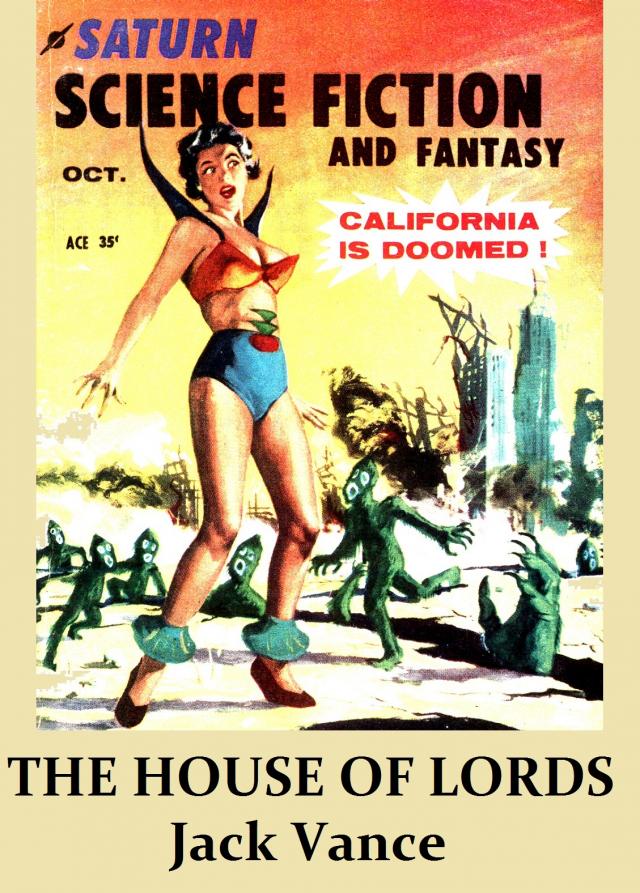
THE HOUSE LORDS
The inhabitants of that planet in Argo Navis were not only human, they were English-speaking, Earth-type humans! But instead of making it easier to get along with them, their culture teas the most incomprehensible in the universe—until the explorers returned home!
by JACK VANCE
From : Saturn, October 1957 edition – short story
Illustrations - uncredited
Synopsis: Their culture seemed utterly incomprehensible
THE TWO men, with not a word spoken, had become very disturbed. Caffridge, the host, rose to his feet, took quick steps back and forth across the room. He went to the window, looked into the sky, toward the distant star BGD 1169. The guest, Richard Emerson, was affected to an even greater degree. He sat back in his chair, face white, mouth loose,
eyes wide and glistening.
Nothing had been said and there was nothing visible to explain their emotion. They sat ii. an ordinary suburban living room, notable only for a profusion of curios, oddities and trinkets hanging on the walls.
At a scratching sound, Caf-. fridge turned from the window. He called sharply, “Sarvis!” The black and white cat,
sharpening its claws on a carved column of exotic wood, laid its ears back, but continued to scratch.
“You rascal!” Caffridge picked up the cat, hustled him outside through the animal’s special door. He returned to Emerson. “We seem to be thinking the same thought.” Emerson was gripping the arms of. his chair. “How did I miss it before?” he muttered.
“It’s a strange business,” said Caffridge. “I don’t know what we should do.”
“It’s out of my hands now, thank heaven!” said Emerson.
Caffridge picked up the small white box which contained Emerson’s report. “Do you want to come along with me?” Emerson shook his head. “I’ve nothing more to say. I don’t want to see that again.” He nodded toward the box.
“Very well,” said Caffridge gloomily. “I’ll show this to the Board tonight. After that.. .” Emerson smiled, weary and skeptical. “After that, what?”
THE ASTROGRAPHICAL SOCIETY functioned as a nonprofit organization, devoted to extraterrestrial research and exploration. The dues paid in by a million active members were augmented by revenue from special patents and grants, licenses and counseling fees, with the result that over the years the Society had become very wealthy. A dozen spaceships carried the blue and green Astrographical chevron to remote places; the monthly publication was studied by school children and savants alike; the Astrographical Museum housed a wonderful melange of objects gathered across the universe.
In a specially equipped cupola on the roof of the museum, the Board of Directors met once a month to transact business and to watch and hear vitaliscope reports from research teams. Theodore Caffridge, Chairman of the Board, arriving at the meeting, dropped the box containing Team Commander Richard Emerson’s report into the vitaliscope mechanism. He stood silently, a tall somber figure, w a i t i n g while conversation around the table died.
“Gentlemen,”^said Caffridge in a dull monotone, “I have already examined this report. It is the strangest matter of my experience. I am seriously disturbed, and I may remark that Commander Emerson shares my feeling.”
He paused. The Directors looked at him curiously.
“Come, Caff ridge, don’t be mysterious!”
“Let’s hear it, Theodore!” Caffridge smiled the faintest, most remote smile possible. “The report is here; you can see for yourselves.”
He touched a switch; the walls of the room dissolved into gray mist; colors swirled and cleared. The Board of Directors became a cluster of invisible eyes and ears in the cabin of the spaceship Gaea. Their vantage point was the recording globe at the peak of Emerson’s helmet. They saw what he saw, heard what he heard.
Emerson’s voice came from a speaker. “We are in’ orbit over planet Two of star BGD one-one-six-nine, in Argo Navis Four. We were attracted here by a series of pulses radiating in the C-three phase. These would seem to indicate a highly organized technical civilization, so naturally we stopped to investigate.”
The images around the walls of the room shifted as Emerson stepped up into the control pit. Through the observation port the Directors could see a world swinging below, in the full light of an invisible sun.
Emerson detailed the physical characteristics of the world, which resembled those of Earth. “The atmosphere seems breathable; there is vegetation roughly comparable to our own.”
Emerson approached the telescreen; again the images around the walls shifted. “The signals had led us to expect some sort of intelligent occupancy. We were not disappointed. The autochthons live, not in organized settlements, but in isolated dwellings. For lack of a better word, we’ve been calling them palaces.” Emerson adjusted a dial on the console; the view on the telescreen expanded enormously and the Directors were looking into a forest as dense as a jungle. The view shifted across the treetops to a clearing about ^ a mile in diameter. The “palace” occupied the center of the clearing —a dozen tall walls, steep and high as cliffs, joined apparently at random. They were constructed of some shimmering metalloid substance, and open to the sky. No portals or apertures were visible.
“That’s about all the detail I can pick up from this altitude,” came Emerson’s voice. “Notice the absence of roof, the apparent lack of interior furnishing. It hardly seems a dwelling. Notice also how the clearing is landscaped—like a formal garden.”
He backed away from the telescreen; the Directors once more sat in the cabin of the Gaea. “We have been broadcasting . international symbols in all bands,” said Emerson. “So far there has been no response. I think that we will set down in that clearing. There is an element of risk attached, but I believe that a race apparently so sophisticated will neither be surprised nor shocked by the appearance of a strange spaceship.”
THE GAEA settled into the atmosphere of BGD 1169-2, and the hull shivered to the slur of the thin gas whipping past.
Emerson spoke into the vitaliscope pickup, noting that the ship hovered above the area previously observed and was about to land..
The bumpers struck solid ground. There was a momentary fluctuation as the automatic stabilizers took hold; then a sense of anchorage. Automatic switches cut off impulsion; the half-heard whine died down the scale into silence. The crew stood at the observation posts, staring out over the clearing.
At the center rose the palace —tall planes of glistening metalloid. Even from this close view, no openings, no windows, no doors or vents could be seen.
The grounds surrounding the palace were carefully tended. Avenues of white-trunked trees held square black leaves, large as trays, turned up to the sun. There were irregular beds of black moss, feathery maroon ferns, fluffy pink and white growths like cotton candy. In the background rose the forest; a tangle of blue-green trees and broad-leaved shrubs, red, black, gray, and yellow.
Inside the Gaea the crew stood by the ports, ready to depart at any sign of hostility.
The palace remained quiet.
Half an hour passed. A small shape appeared briefly outside the wall of the palace. Cope, the young third officer, saw it first and called to Emerson. “Look there!”
Emerson focused the telescopic bull’s-eye. “It’s a child —a human child!”
The crew came to stare. Intelligent life among the stars was a rarity; to find such life in the human mold was cause for astonishment.
Emerson increased the magnification of the telescopic pane. “It’s a boy, about seven or eight,” he said. “He’s looking at us, but he doesn’t seem particularly interested.”
The child turned back to the palace, and disappeared. Emerson uttered a soft ejaculation. “Did you see that?”
“What happened?” asked Wilhelm, the big blond second officer.
“He walked through the wall! As if it were air!”
Time passed; there was no further show of life. The crew fidgeted. “Why don’t they show some interest?” complained Swett, the steward. “Even the kids walk away.” Emerson shook his head in puzzlement. “Spaceships certainly don’t drop down every day.”
Wilhelm suddenly called out, “There’s more of them—two, three, six—a whole confounded tribe!”
THEY CAME from the for-est, quietly, almost stealthily, singly and in pairs, men and women, until a dozen stood near the ship. They wore smocks woven of coarse fiber, crude leather shoes with flaring tops. At their belts hung daggers of several sizes and complicated little devices built of wood and twisted gut. They were a hard-bitten lot, with heavy-boned faces and glinting eyes. They walked with a careful bend to the knee, which gave them a furtive aspect. They kept the ship between themselves and the palace at all times, as if anxious to escape observation.
Emerson said, “I can’t understand it. These aren’t just humanoid types; they’re human in every respect!” He looked across to where Boyd, the biologist, was finishing his final tests. “What’s the story?”
“Clean bill of health,” said Boyd. “No dangerous pollen, no air-borne proteides, nothing remarkable in any way.”
“I’m going to step outside,” said Emerson.
Wilhelm protested, “They look untrustworthy and they’re armed.”
“I’ll take a chance,” said Emerson. “If they were hostile, I don’t think they’d expose themselves.”
Wilhelm was not convinced. “You never can tell what a strange race has in mind.”
“Nevertheless,” said Emerson, “I ’m going out. You fellows cover me from the gun blisters. Also stand by the engines, in case we want to leave in a hurry.”
“Are you going out alone?” Wilhelm asked dubiously.
“There’s no point risking two lives.”
Wilhelm’s square raw-bones face took on a mulish set. “I’ll go out with you. Two eyes see better than one.”
Emerson laughed. “I’ve already got two eyes. Besides, you’re second in command; your place is here in the ship.” Cope, the young third officer, slender and dark, hardly out of his teens, spoke. “I’d like to go out with you.” “Very well, Cope,” said Emerson. “Let’s go.”
Ten minutes later the two men stepped out of the ship, descended the ramp, stood on the soil of BGD 1169-2. The men and women from the forest still stood behind the ship, peering from time to time toward the palace. When Emerson and Cope appeared, they drew together, ready for either attack, defense or flight. Two of them fingered the wooden contrivances at their belts, which Emerson saw to be dart catapults. But otherwise there was no motion, friendly or otherwise.
The spacemen halted twenty feet distant. Emerson raised his hand, smiled la what be hoped to be a friendly manner. “Hello.”
They stared at him, then began muttering among themselves. Emerson and Cope moved a step or two closer; the voices became audible. A lank, gray-haired man, who seemed to wield a degree of authority, spoke with peevish energy, as if refuting nonsense. “No, no—impossible for them to be Freemen!”
The gnarled, beady-eyed man to whom he spoke retorted, “Impossible? What do you take them for, then, if not Freemen?”
Emerson and Cope stared in amazement. These men spoke English!
Someone else remarked, “They’re not House Lords! Who ever saw House Lords like these!”
A fourth voice was equally definite. “And it’s a certainty that they’re not servants.”
“All of you talk in circles,” snapped one of the women. “Why don’t you ask them and be done with it?”
English! The accent was blurred, the intonation unusual, but the language, nonetheless, was their own! Emerson and Cope came a step closer; the forest people fell silent, and shifted their feet nervously.
Emerson spoke. “I am Robert Emerson,” he said. “This is Howard Cope. Who are you people?”
The gray-haired chief surveyed them with crafty impudence. “Who are we? We’re Freemen, as you must know very well. What do you here? What House are you from?”
Emerson said, “We’re from Earth.”
“Earth?”
Emerson looked around the blank faces. “You don’t know of Earth?”
“No.”
“But you speak an Earth language! ”
The chief grinned. “How else can men speak?”
Emerson laughed weakly. “There are a number of other languages.”
The chief shook his head skeptically. “I can’t believe that.”
Emerson and Cope exchanged glances of bewildered amusement “Who lives in the palace?” Emerson asked.
The chief seemed incredulous at Emerson’s ignorance. “The House Lords, naturally. Genarro, Hesphor and the rest.”
Emerson considered the tal walls, which seemed, on the whole, ill-adapted to human acquirements. “They are men, like ourselves?”
The chief laughed jeeringly. “If you would call such luxurious creatures men! We tolerate them only for their females.” From the men of the group came a lascivious murmur. “The soft, sweet House Lord girls!”
The forest women hissed in anger. “They’re as worthless as the men!” exclaimed one leathery old creature.
There was a sudden nervous motion at the outskirts of the group. “Here they come! The House Lords!”
Quickly, with long, bent-kneed strides, the savages retreated, and were gone into the forest.
EMERSON and Cope walked ~ around the ship. Crossing the clearing in leisurely fashion were a young man, a young woman, a girl and the boy they had seen before. They were the most handsome beings the Earthmen had ever seen. The young man wore a skintight garment of emerald-green sequins, a complicated headdress of silver spines; the boy wore red trousers, & dark blue jacket and a long-billed blue cap. The young woman and the girl wore simple deaths of white end blue, stretching with easy elasticity as they walked. They were bareheaded and their pale hair fell flowing to their shoulders.
They halted a few yards from the ship, considered the spacemen with sober curiosity. Their expressions were identical; intent, intelligent, with a vague underlying hauteur. The young man glanced casually toward the forest, held up a small rod. A puff of darkness came forth and a black bubble wafted toward the forest, expanding enormously as it went.
From the forest came yelps of fear, the stumble of racing feet. The black bubble exploded among the trees, scattering hundreds of smaller black bubbles, which grew and exploded in their turn.
The sound of flight diminished in the distance. The four young House Lords, smiling a little, returned their attention to Emerson and Cope.
“And who may you be? Surely not Wild Men?”
“No, we’re not Wild Men,” said Emerson.
The boy said, “But you’re not House Lords.”
“And certainly you’re not servants,” said the girl, who was several years older than the boy, perhaps fourteen or fifteen.
Emerson explained patiently, “We are astrographers, scientists, from Earth.”
Like the forest people, the House Lords were puzzled. “Earth?”
“Good Heavens!” exclaimed Emerson. “Surely you know of Earth!”
They shook their heads. “But you’re human beings— Earth people!”
“No,” said the young man, “We are House Lords. ‘Earth’ is nothing to us.”
“But you speak our language —an Earth language!”
They shrugged and smiled. “There are a hundred ways in which your people might have learned our speech.”
The matter seemed to interest them very little. The young woman looked toward the forest. “Best be careful of the Wild Men; they’ll do you harm if they can.” She turned. “Come, let us go back.” “Wait!” cried Emerson. They observed him with austere politeness. “Yes?”
“Aren’t you curious about us, or interested in where we came from?”
The young man smilingly shook his head, and the silver spines of his headgear chimed like bells. “Why should we be interested?”
Emerson laughed in mingled astonishment and irritation. “We’re strangers from space— from Earth, which you claim you never heard of.”
“Exactly. If we have never heard of you, how can we be interested?”
Emerson threw up his hands. “Suit yourself. However, we’re interested in you.”
The young man nodded, accepting this as a matter of course. The boy and girl were already walking away; the young woman had half-turned and was waiting. “Come, Hesphor,” she called softly.
“I’d like to talk to you,”; Emerson said. “There’s a mystery here—something we should straighten out.”
“No mystery. We are House Lords, and this our House.” “May we come into your house?”
The young man hesitated, glanced at the young woman. She pursed aer lips, shook her head. “Lori Genarro.”
The young man made a small grimace. “The servants are gone; Genarro sleeps. They may come for a short time.” The young woman shrugged. “If Genarro wakes, he will not be pleased.”
“Ah, but Genarro—”
“But Genarro,” the woman
interrupted quickly, “is the First Lord of the House!” Hesphor seemed momentarily sulky. “Genarro sleeps, and the servants are gone. These wild things may enter.”
He signaled to Cope and Emerson. “Come.”
THE HOUSE Lords strolled back through the garden, talking quietly together. Emerson and Cope followed, half angry, half sheepish. “This is fantastic,” Emerson muttered. “Snubbed by the aristocracy half an hour after we arrive.” “I guess we’ll have to put up with it,” said Cope. “They know things we’ve never even thought of. That black bubble, for instance.”
The boy and girl reached the wall of the palace. Without hesitation they walked through the glistening surface. The young man and woman followed. When Emerson and Cope reached the wall, it was solid, super-normally cold. They felt along the smooth surface, pushing, groping in exasperation.