Samson 04 faith, p.1
Samson 04 - Faith, page 1
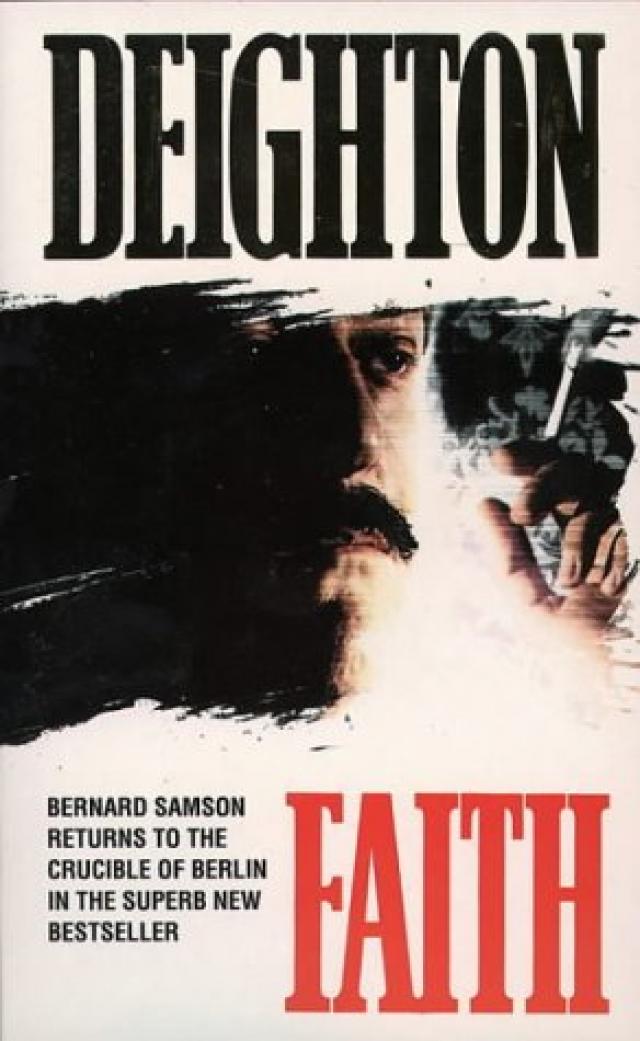


LEN DEIGHTON
FAITH
A Bernard Sampson Novel
CHAPTER 1
“Don’t miss your plane, Bernard. This whole operation depends upon the timing.” Bret Rensselaer peered around to spot a departures indicator; but this was Los Angeles aiiport and there were none in sight. They would spoil the architect’s concept.
“It’s okay, Bret,” I said. He would never have survived five minutes as a field agent. Even when he was my boss, driving a desk at London Central, he’d been like this; repeating the instructions, wetting his lips, dancing from one foot to the other and furrowing his brow as if goading his memory.
“Just because Comrade Gorbachev is kissing Mrs. Thatcher and spreading that glasnost schmaltz in Moscow, it doesn’t mean those East German bastards are buying any of it. Everything we hear says the same thing: they are more stubborn and vindictive than ever.”
“It will be just like home,” I said.
Bret sighed. “Try and see it from London’s point of view,” he said with exaggerated patience. “Your task was to bring Mona across the wire as quickly and quietly as possible. But you fixed it so your farewell performance out on that Autobahn was like the last act of Hamlet. You shoot two bystanders, and your own sisterin-law gets killed in the crossfire.”
He glanced at my wife Mona, who was still recovering from seeing her sister Tessa killed. “Don’t expect London Central to be waiting for you with a gold medal, Bernard.”
He’d bent the facts but what was the use of arguing? He was in one of his bellicose moods, and I knew them well. Bret Rensselaer was a slim American who’d aged like a rare wine: growing thinner, more elegant, more subtle and more complex with every year that passed. He looked at me as if expecting some hot-tempered reaction to his words. Getting none, he looked at my wife. She was older, too, but no less serene and beautiful.
With that face, her wide cheekbones, flawless complexion and luminous eyes, she held me in thrall as she always had done. You might have thought that she was completely recovered from her ordeal in Germany. She was gazing at me with love and devotion and there was no sign she’d heard Bret.
Sending me to do this job in Magdeburg was not Bret’s idea. I’d caught sight of the signal he sent to London Central telling them that I was no longer suited to field work, particularly in East Germany. He’d asked them to chain me to a desk until pension time rolled around. It sounded considerate, but I wasn’t pleased. I needed to do something that would put me back in Operations; that was my only chance of being promoted and getting a senior staffposition in London. Unless my position improved I would wind up with a premature retirement and a pension that wouldn’t pay for a cardboard box to live in.
I nodded. Bret always observed the niceties of hospitality. He had driven us to Los Angeles airport through a winter rainstorm to say goodbye.
They could watch me climb onto the plane bound for Berlin, and my assignment. Then he would put Fiona on the direct flight to London. The Wall was still there and people were getting killed while climbing over it.
Now Bret was just repeating all the things he’d told me a thousand times before, the way people do when they are saying goodbye at airports.
“Keep the faith,” said Bret, and in response to my
blank look he added: “I’m not talking about timetables or statistics or training manuals. Faith. It’s not in here.” He tapped his forehead. “It’s in here.” Gently he thumped his heart with a flattened palm so that the signet ring glittered on his beautifully manicured hand, and a gold watch peeped out from behind a starched linen cuff.
“Yes, I see. Not a headache; more like indigestion,” I said. Fiona watched us and smiled.
“They are calling the flight,” said Bret.
“Take care, darling,” she said. I took Fiona in my arms and we kissed decorously, but then I felt a sudden pain as she bit my lip. I gave a little yelp and stepped back from her. She smiled again. Bret looked anxiously from me to Fiona and then back at me again, trying to decide whether he should smile or say something. I rubbed my lip. Bret concluded that perhaps it was none of his business after all, and from his raincoat pocket he brought a shiny red paper bag and gave it to me. It was secured with matching ribbon tied in a fancy gift-wrap bow. The package was slightly limp; like a paperback book.
“Read that,” said Bret, picking up my carry-on bag and shepherdiDg me toward the gate where the other passengers were standing in line. It seemed as if it would be a full load today; there were women with crying babies and long-haired kids with earrings, well-used backpacks and the sort of embroidered jackets that you can buy in Nepal. Fiona followed, observing the people crowding around us with that detached amusement with which she cruised through life. With one phone call Bret could have arranged for us to use any of the VIP lounges on the airport, but the Department’s guidelines said that agents traveling on duty kept to a low profile, and so that’s what Bret did. That’s why he’d left his driver behind at the house and taken the wheel of the Accord. Like other Americans before him, he had an exaggerated respect for what the people in London thought was the right way to do things. We reached the gate. I couldn’t go through until he dalided over my carry-on bag.
“Maybe all this hurry-hurry from London will work out for the best, Bernard. Your few days chasing around East Germany will give Fiona a chance to get your London apartment ready. She wants to do that for you.
She wants to settle down and start all over again.” He looked at her and waited until she nodded in agreement.
Only Bret, would have the chutzpah to explain my wife to me while she was standing beside him. “Yes, Bret,” I said. There was no sense in telling him he was out of line. Another few minutes and I’d be rid of him for ever.
“And don’t go chasing after Werner Volkmann.”
“No,” I said.
“Don’t give me that glib no-of-course-not routine. I mean it. Whatever Werner did to them, London Central hate him with a passion beyond compare.”
“Yes, you told me that.”
“You can’t afford to step out of line, Bernard. If someone spots you having a cup of coffee with your old buddy Werner, everyone in London will be saying you are part of a conspiracy or something. God knows what he did to them but they hate him.”
“I wouldn’t know where to find him,” I said.
“That’s never stopped you before.” Bret paused and looked at his watch.
“Be a model employee. Put your faith in the Department, Bernard. Swallow your pride and tug your forelock. Now that London Central’s funds are being so severely cut, they are looking for an excuse to fire people instead of retire them. No one’s job is safe.”
“I’ve got it all, Bret,” I said, and tried to prize my bag away from him.
He smiled and moistened his lips, as if trying to resist giving me any more advice and reminders. “I hear Tante Lisl has had a check-up. If she’s going to have a hip replacement, or whatever it is, trying to save a few bucks on it is dumb.”
That was his way of saying that he’d pay old Frau Hermig’s doctor’s bills. I knew Bret well. We’d had our ups and downs, especially when I thought he was chasing Flona, but I’d got to know him better during my long stay in California. As far as I could tell, Bret wasn’t a double-crosser. He didn’t lie or cheat or steal except when ordered to do so, and that put him into a very tiny minority of the people I worked with. He handed over my bag and we shook hands. We were out of earshot of Mona and anyone else.
“This Russkie who’s asking for you, Bernard,” he whispered. “He says he owes you a favor, a big favor.”
“So you said.”
VERDI: that’s his codename of course.” I nodded solemnly. I’m glad Bret told me that or I might have arrived expecting an aria from La Tmviata.
“A colonel,” he coaxed me. “His father was a junior lieutenant with one of the first Red Army units to enter Berlin in April ‘45 and stayed there to become a staff officer at Red Anny headquarters, on long-term political assignment at Berlin-Karlshorst. Dad married a pretty German frdulein, and VERDI grew up more Gennan than Russian … so the KGB
grabbed him. Now he’s a colonel and wants a deal.” Having gabbled his way through this description he paused. “And you still can’t guess who he might be?” Bret looked at me. Surely he knew I wasn’t going to start that kind of game; it would open a can of worms that I wanted to keep tightly shut.
“Do you have any idea how many hustlers out there answer thal, kind of description?” I said. “They all have stories like that. Seems like those first few Ivans into town fathered half the population of the city.”
“That’s right. Play it close to the chest,” said Bret. “That’s always been your way, hasn’t it?” He so wanted to be in London, and be a part of it again, that he actually envied me. It was almost laughable. Poor old Bret was past it; even his friends said that.
“And your girlfriend,” whispered Bret. “Gloria. Make sure that’s dl over and done with.” His voice was edged with the indignant anger that we all feel for other men’s philandering. “Try to hang on to both of them and you’ll lose Mona and the children. And maybe your job, too.”
I smiled mirthlessly. The airline girl ripped my boarding pass in half and before I went down the jetty I turned back to wave to them. Who would have guessed that my wife was a revered heroine of the Secret Intelligence Service? And with every chance of becoming its DirectorGeneral, if Bret’s opinion was anything to go by. At this moment Mona looked like a
Bret was standing there in his short black raincoat; as still and expressionless as a stone statue. His fair hair was now mostly white and his face gray. And he was looking at me as if imprinting this moment on his memory; as if he was never going to see me again.
As I walked down the enclosed jetty toward the plane a series of scratched plastic windows, rippling with water, provided a glimpse of rain-lashed palm trees, lustrous engine cowling, sleek tailplane and a slice of fuselage. Rain was glazing the jumbo, making its paintwork shiny like a huge new toy; it was a hell of a way to say goodbye to California.
“First Class?”
Airlines arrange things as if they didn’t want you to discover that, you were boarding a plane, so they wind up with something like a cramped roadside diner that smells of cold coffee and stale perspiration and has exits on both sides of the ocean.
“No,” I said. “Business.” She let me find my own assigned place. I put my carry-on bag into the overhead locker, selected a German newspaper from the display and settled into my seat. I looked out of the tiny window to see if Bret was pressing his nose against the window of the departure lounge but there was no sign of him. So I settled back and opened the red bag that contained his going-away present. It was a Holy Bible. Its pages had gold edges and its binding was of soft tooled leather. It looked very old. I wondered if it was some sort of Rensselaer family heirloom.
“Hi there, Bernard.” A man named “Tiny” Timmermann called to me from his seat across the aisle. A linguist of indeterminate national origins-Danish maybe-he was a baby-faced, 250-pound wrestler, with piggy eyes, close-cropped skull and heavy gold jewelery. I knew him from Berlin in the old days when he was some kind of well-paid consultant to the US State Department. There was a persistent rumor that he’d strangled a Russian ship’s captain in Riga and brought back to Washington a boxful of manifests and documents that gave details of the nuclear dumping the Russian Navy was doing into the sea off Archangel. Whatever he’d done for them, the Americans always seemed to treat him generously, but now, the rumors said, even Tiny’s services were for hire.
“Good to see you, Tiny,” I said.
“Hals and Beinbruch!” he said, wishing me good fortune as if dispatching me down a particularly hazardous ski-run. It shook me. Did he guess I was on an assignment? And if news of it had reached Tiny who else knew?
I gave him a bemused smile and then we were strapping in and the flight attendant was pretending to blow into a life-vest, and after that Tiny produced a lap-top computer from his case and started playing tunes on it as if to indicate that he wasn’t in the mood for conversation.
The plane had thundered into the sky, banked briefly over the Pacific Ocean and set course northeast. I stretched out my legs to their full Business Class extent and opened my newspaper. At the bottom of the front page a discreet headline, “Erich Honecker proclaims Wall will still exist in 100 years,” was accompanied by a smudgy photo of him. This optimistic expressed view of the General Secretary of the Central Committee of the SED, the party governing East Germany, seemed like the sincere words of a dedicated tyrant. I believed him.
I didn’t read on. The newsprint was small and the gray daylight was not much helped by my dim overhead reading light. Also my hand trembled as it held the paper. I told myselfthat it was a natural condition arising from the rush to the airport and carrying a ton of baggage from the car while Bret fought off the traffic cops. Putting the newspaper down I opened the Bible instead. There was a yellow sticker in a page marking a passage from St Luke:
For I tell you, that many prophets and kings have desired to see those things which ye see, and have not seen them; and to hear those things which ye hear, and have not heard them.
Yes, very droll, Bret. The only inscription on the flyleaf was a pencilled scrawl that said in German “A promise is a promise!” It was not Bret’s handwriting. I opened the Bible at random and read passages but I kept recalling Bret’s face. Was it his imminent demise I saw written there? Or his anticipation of mine? Then I found the letter from Bret. One sheet of thin onion-skin paper, folded and creased so fightly that it made no bulge in the pages.
“Forget what happened. You are off on a new adventure,” Bret had written in that loopy coiled style that characterizes American script. “lAke Kim about to leave his father for the Grand Trunk Road, or Huck Firm starting his journey down the Mississippi, or Jim Hawkins being invited to sail to the Spanish Caribbean, you are starting all over again, Bernard. Put the past behind you. This time it will all be different, providing you tackle it that way.”
I read it twice, looking for a code or a hkiden message, but I shouldn’t have bothered. It was pure Bret right down to the literary cliches and flowery good wishes and encouragement. But it didn’t reassure me. Kim was an orphan and these were all fictional characters he was comparing me with. I had the feeling that these promised beginnings in distant lands were Bret’s way of making his goodbye really final. It didn’t say Come back soon.
Or why-; Bret’s message about me and Mona, about our starting our marriage anew? Mona’s pretended defection to the East was being measured by the valuable encouragement she’d given to the Church in its opposition to the cominunists. Only I could see the price she had paid. In the last couple of weeks she’d been confident and more vivacious than I could remember her being for a very long time. Of course she was never again going to be like Me Mona I’d first met, that eager young Oxfordeducated adventurer who had crewed an oceangoing yacht and could argue dialectical materialism in almost perfect French while cooking a souffI6. But if she was not the same person she’d once been, then neither was 1. No one could be blamed for that. We’d chosen to deal in secrets. And if her secret task had been so secret that it had beer, kept concealed even from me then I would have to learn not to resent that exclusion.
When the flight attendant brought champagne and a liver compound spread on tiny circles of toast I gobbled everything down as I always do, because my mind was elsewhere. I still couldn’t help thinking about Honecker and Bret and the Wall. It’s true that things were slowly changing over there; financial loans and political pressure had persuaded them to make the Stasi dig up and discard a few of the land-mines and automatic firing devices Irom the “death-strip” along the Wall. But the lethal hardware remaining was more than enough to discourage spontaneous emigration. I suppose Western intelligence was changing equally slowly; people like me and “Tiny” were no longer traveling First Class. As I drifted off to sleep I was wondering how long it would be before that professional egalitarian Erich Honecker found himself adjusting to the rigours of flying Economy.
“Did you manage to sleep on the plane?” said the young Englishman who met me at the airport in Berlin and took me to his apartment. He put my luggage down and closed the door. He was a tall thin thirty-year-old with an agreeable voice, a pale face, uneven teeth and a certain diffident awkwardness that sometimes afflicts tall people. I followed him into the kitchen of his apartment in Moabit, near Turmstrasse U-Bahn. It was the sort of grimy little place that young people will endure in order to be near the bright lights. As a long-time resident of the city I knew it as one of the apartment blocks hastily built in the ruins soon after the war, and nowadays showing their age.