

Short war, p.1
Short War, page 1


PRAISE FOR SHORT WAR
“Lily Meyer’s Short War is a breathtaking debut: a deeply felt portrait of youth and longing, and also a geopolitical barnburner of a story that spans continents and generations, exposing US foreign policy on the scale of an intimate human drama. Meyer’s prose is beautifully understated, conjuring up a style on her own. Short War is the most assured debut I’ve read in a very long time. This is the announcement of a major new talent.”
—DWYER MURPHY, author of The Stolen Coast
“Lily Meyer has all the sensitivity to language and nuance that comes from being an experienced translator as well as a gifted writer, deftly alternating between lighthearted romance, life-or-death political intrigue, and literary mystery. A stellar roller coaster of a debut.”
—MEGAN MCDOWELL, translator of Seven Empty Houses, winner 2022 National Book Award for Translated Literature
“Short War is extraordinary. Any debut novelist would be gratified and delighted to pull off a compelling love story or a propulsive mystery or a tangled family drama or a devastating political and historical novel—but somehow Lily Meyer manages to do all of that here in this ambitious, suspenseful, and beautifully constructed book.”
—CHRIS BACHELDER, author of The Throwback Special
“This compelling mix of political thriller with bildungsroman cutting across generations and nations blazes a pathway for the contemporary novel. Short War is bittersweet and sexy, a melancholy fable of the trauma of fascism that is both an American story and a transnational grief. What a gift to have storytellers like Lily Meyer on the rise now.”
—GINA APOSTOL, author of Insurrecto
“Short War is a sharp exploration of the long afterlife and peripheral impact of historical trauma. Meyer vividly introduces a compelling psychological thread and a mystery that unfolds across generations, asking us to consider the personal and structural forces that have shaped us. This debut introduces an important and accomplished new literary voice.”
—DANIELLE EVANS, author of The Office of Historical Corrections
“Lily Meyer writes with transfixing concision. In this excellent, assured first novel, Meyer’s knowledge of Chile comes vividly to life. Short War is astute and absorbing, a complex novel about adolescence and the insidious role of the United States in the Pinochet dictatorship.”
—IDRA NOVEY, author of Take What You Need
“I think I left a little bit of my soul behind after reading Lily Meyer’s Short War. Meyer has an unparalleled ability to get into her characters’ heads and emotions, whether it’s teenage lust or adult rage. And even if you’re not an expert on CIA-backed coups, she is also excellent at giving you enough historical detail while never losing sight of the story and fully immersing you in the landscape and culture. There are family secrets, survivor guilt, hopelessness and hope; this short novel manages to contain them all.”
—ANTON BOGOMAZOV, Politics and Prose
SHORT WAR
A NOVEL
LILY MEYER
Published by A Strange Object, an imprint of Deep Vellum
Deep Vellum is a 501(c)(3) nonprofit literary arts organization founded in 2013 with the mission to bring the world into conversation through literature.
Copyright © 2024 Lily Meyer. All rights reserved.
No part of this book may be used or reproduced in any manner without written permission from the publisher, except in the context of reviews.
Library of Congress Cataloging-in-Publication Data
Names: Meyer, Lily, author.
Title: Short war : a novel / Lily Meyer.
Description: Dallas, Texas : Deep Vellum ; Austin, Texas : A Strange Object, 2024.
Identifiers: LCCN 2023039417 (print) | LCCN 2023039418 (ebook) | ISBN 9781646053155 (trade paperback) | ISBN 9781646053308 (ebook)
Subjects: LCSH: Americans—South America—Fiction. | Families—Fiction. | LCGFT: Political fiction. | Novels.
Classification: LCC PS3613.E9735 S48 2024 (print) | LCC PS3613.E9735 (ebook) | DDC 813/.6—dc23/eng/20231109
LC record available at https://lccn.loc.gov/2023039417
LC ebook record available at https://lccn.loc.gov/2023039418
Cover design by Emily Mahon
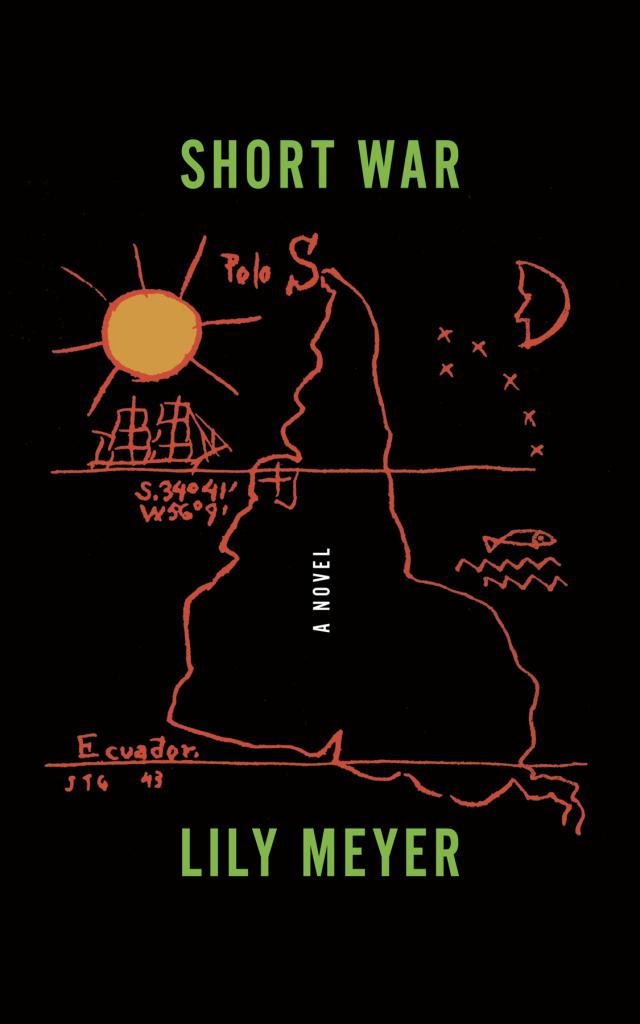
Cover art: América Invertida (Inverted Map), courtesy of the Estate of Joaquín Torres-García
Interior design and layout by Amber Morena
To my father, who is a real writer
It’s complicated, being an American,
Having the money and the bad conscience, both at the same time.
—LOUIS SIMPSON, “ON THE LAWN AT THE VILLA”
CRISIS
Santiago, Chile, April 1973
A girl was walking toward Gabriel Lazris. A girl in a green miniskirt. She was across the packed basement, between the makeshift dance floor and the card table laden with booze, but he knew, with inexplicable, terrifying certainty, that she was coming for him. Faint light seemed to rise from her pale hair, illuminating her path through the human mass of Ítalo Ibáñez’s seventeenth birthday. She held herself upright, like a dancer, but she moved toward Gabriel, who was folding himself into the corner of the tiny, tile-floored kitchenette, with determination rather than grace.
Nobody else was looking at her. His friends hadn’t noticed her approach. Gabriel tried not to stare, but how could he not? She was glowing. Also, she seemed to have extremely important business to conduct with him, though realistically, her agenda probably involved not Gabriel but the beer-filled fridge. She probably didn’t even see him. In the years he’d lived in Chile, Gabriel had spent a lot of time asking God to make him invisible. Maybe his prayers had been heard.
In the future, Gabriel would return often to this moment. He would imagine descending from the cloud of memory, elbowing his sixteen-year-old self, telling him how close he was to the true start of his life. He would never shake the belief that without Caro Ravest, he was less than his full self, though their relationship lasted less than six months. That September, the Chilean military, covertly backed by the United States, overthrew Salvador Allende’s Socialist government. Before the coup, Gabriel was in love; he had plans; he had friends. After, he was a lonely American kid in a lonely American suburb, writing frantic letters to politicians who couldn’t care less that his girlfriend had disappeared.
Party heat rolled through the basement. A Los Golpes song played, all jangled harmonies and rough, poppy guitars. Boys slouched in corners, sprawled on couches, straddled turned-around chairs. Girls filled the improvised dance floor, wiggling and tugging at their clothes. From his corner of the kitchen, Gabriel could hear Carlos Aldunante, his worst classmate, monologuing on the virtues of neofascism. He saw Ítalo squinting through the viewfinder of a boxy black camera. He smelled joss sticks smoldering on the kitchenette counter. Somebody had abandoned a school tie beside them, which seemed like a hazard. Those ties were 100 percent polyester and—Gabriel knew from a Hanukkah-candle incident—highly flammable. He moved it to safety, feeling pleased with himself. He’d contributed to the party now.
Nico Echevarría and Andrés Saavedra, Gabriel’s best and only friends, were bickering over their beloved soccer team, Colo-Colo, which had played like shit in Wednesday’s championship qualifier. Andrés thought the problem was bad goalkeeping; Nico thought the problem was God. Gabriel thought the glowing girl was approaching swiftly. She was very pretty, and very much looking at him. He agreed with Nico, but more importantly, he needed his friends to quit play-fighting and help him out.
She walked into the kitchen, smiling. Up close, she went far beyond pretty, into the horrifying terrain of the legitimately beautiful. Maybe that explained the glow. Gabriel glanced away from her, just to confirm that he could, and took a slug of his terrible drink. Nico had decided the correct mix for the night was pisco, red wine, and Coke. A great experimenter, Nico Echevarría.
Andrés finally spotted the girl. “Hey, Caro,” he said, lifting his chin. “How’s it going?” Gabriel hadn’t realized that his friend knew her. Absurdly, he felt a stab of jealousy.
“Fine.” She shrugged and pushed her hair back, showing a hot, irregular birthmark climbing her neck. It was reddish-purple and rough-looking, like a dried pool of spilled paint. She smiled directly at Gabriel, which made a muscle in his jaw seize. Before he could unclench it, she said, “You’re Gabriel, right?”
His first impulse was to deny. To say, What’s a Gabriel? But she’d crossed the room to talk to him, and he, somehow, had known it. Surely this was his chance. Gabriel had been sixteen for half a year now, and he’d still never kissed a girl. Not for lack of wanting, either. He just had no clue how to act. His inner voices were not helpful. Right now, for instance, they were suggesting very strongly that he pretend not to speak Spanish, or maybe hide in the fridge. Anything to keep Caro from discovering that he was the human idiot: useless, hopeless, and thoroughly unworthy of her time.
She tilted her head. “The American friend?”
Nico reached over to ruffle Gabriel’s curls. “You got it. Our quiet American.”
“Good book,” Caro said, alarming Gabriel still more. He didn’t know what book she meant. “And sorry for ambushing you. My cousin Alejandra is Andrés’s neighbor. She sent me to introduce myself.”
Nico shuffled his feet. He’d dated Alejandra over the summer. She’d dumped him in January for sex reasons, or Catholic reasons, depending on your perspective.
“It wasn’t an ambush,” Gabriel managed. “I mean, not a bad one.”
Nico winked at Caro. “See?
Amusement flickered in her eyes. “I’ve never heard of a good ambush.”
“Surprise parties?” Gabriel offered.
“Ever had one?”
He shook his head.
“Alejandra threw me one last year.” Caro wrapped her hair around her hand. “Not good.”
“Why’d she send you over?” Gabriel asked, belatedly surprised. He and Alejandra weren’t exactly close. In general, he was startled when she remembered he existed. He’d known her for nearly nine years, but he still had an impulse, every time he saw her, to reintroduce himself.
“Some guy we don’t know was telling us about his trip to Miami, and I said I’d never even met an American, or any foreigners except the German nuns at our school. Alejandra thought I was complaining. She said if I was so sick of Chileans, I should come talk to you.”
“Typical,” Andrés said wryly. “I bet Miami Boy is Sebastián Kahl. Caro, did he talk”—he slipped into an imitation of Kahl’s braying voice—“like this?”
Caro giggled. “Maybe.”
“I better rescue your cousin, then. Very difficult to shut Kahl up once he starts bragging.”
“I noticed that.”
“I’ll come,” Nico said. “I should say happy birthday to Ítalo.” His mouth twitched with anticipation. They’d already greeted Ítalo, who’d insisted on photographing them with his new camera, but they hadn’t lingered long enough to see if he had coke. He usually did, and Nico, of the three of them, was by far the best at drugs. Gabriel, though smallest by half a head, was best at drinking. Andrés could chain-smoke a whole pack of cigarettes and not puke.
“Nice seeing you,” Andrés told Caro. Nico reached for the half-empty pisco bottle, poured a stream into Gabriel’s glass and a splash into his own, then led Andrés into the party. Gabriel had to remind himself to stay behind. Talk to Caro. Keep her from wanting to dance. It was not biologically possible for him to be sober enough to converse but drunk enough to dance. It was only narrowly possible for him to dance while still capable of standing up.
He considered his newly disproportionate drink. It smelled like an enemy of self-control. “I think,” he said, “Nico ruined this. And it was terrible to begin with. Would you like a beer?”
“Please.”
Gabriel searched in the fridge, finding two Cristals hiding behind a girl’s shoe. Why was everyone leaving their clothes in the kitchen? Should he ditch his sweater here to join in? He showed Caro the shoe, which made her laugh, then banged the beers on the counter to open them. Neither foamed too much, which was a relief.
“Short war,” he said, lifting his bottle to hers. It was the Lazris toast, adopted or created during World War II. Possibly imperialistic now, but Gabriel liked it. In Spanish, which he alone in his family spoke fluently, it felt like an invention of his own.
“Short war,” Caro echoed. She didn’t question the toast, which Gabriel later realized was highly uncharacteristic. She hated not knowing details. He would come to both envy her curiosity and love it. He’d dig for it in himself and, someday, teach it to his daughter.
Somebody put on João Gilberto, whose soft bossa nova made the whole party sigh and slouch. Caro took a step closer to Gabriel. “You seem less American than I thought,” she said. “Not that I know what Americans are like.”
“Loud and capitalist, I think.”
“And you’re quiet.”
“Quiet and Communist.”
She arched an eyebrow. “I thought Americans hated Communism.”
Gabriel thought of his father. “Most do.”
“I don’t know.” Caro’s voice dipped, and her eyes took on a teasing shine. “I bet you’re as Chilean as I am. I bet the real American Gabriel is halfway across the room.”
Pride rippled through Gabriel, swiftly followed by fear. He didn’t want to seem American—he’d devoted years of energy to sounding, looking, and thinking like a Chilean—but what if she decided he actually was an impostor? If she set off to seek the real Gabriel, she’d never come back. “I wish I were Chilean,” he said. “But I can prove I’m not.”
“How?”
“You speak English?”
“I take it in school.”
Gabriel took a sip of beer. In middle school, before he got exempted from English classes, he’d often used the speed of his English to annoy teachers and make his friends laugh. Now he got to sit in the library while everyone else did languages. He always told himself he’d use that time to read about Socialism, but somehow he never did.
He took a deep breath. In his slowest English, he said, “I was born in McLean, Virginia. I moved to Santiago when I was eight.” João Gilberto plunked and plucked in his ears. Gabriel sped up as he continued: “My dad used to be the Senate correspondent for the Washington Courier. After the Bay of Pigs, he started reporting on Cuba, but we couldn’t move there, I guess. I was little. Anyway, when I was eight, he got made the Courier bureau chief here.” He increased his speed to the pace at which he spoke with his parents. “We moved right before the ’66 World Cup, and—”
“Okay, okay.” Caro flapped a hand at him. “I believe you. I have no idea what you said.”
Gabriel switched back to Spanish, relieved. “Just that I moved here eight years ago.”
“I’m impressed you have no accent.” She pressed a hand to her mouth. “Wait. Shit. Was that a bad compliment?”
“Not at all. I worked hard to get rid of my accent.”
“Does it ever come back?”
“Only if I’m really mad. Or really drunk.”
Caro grinned. She had a dimple in her left cheek. Somebody had switched the record back to Los Golpes, and people were thrashing toward the dance floor. “We better keep drinking, then.”
They swiped a fifth of vodka from the freezer to supplement their beers, then settled on a rolled-up rug at the edge of the room. Andrés, who’d abandoned Alejandra in favor of smoking weed with a pack of soccer players, caught Gabriel’s eye and grinned. Nico was busy flirting with a vaguely familiar-looking girl in bell-bottoms, but turned to do the same. Gabriel ignored them. He couldn’t get distracted. Keeping up with Caro took all his attention. She could move a conversation anywhere: Chilean politics, American politics, Zen Buddhism, Colo-Colo’s Primera División record, her lack of interest in playing team sports, her love of televised Alpine ski races and thwarted dream of learning to ski—lessons and travel would be too expensive—his recent Communist Youth–sponsored hiking trip to La Campana National Park, their shared desire to visit the glaciers in Patagonia someday. Halfway through a description of her fantasy backpacking trip, Caro paused and touched Gabriel’s arm.
“I think I need a cigarette,” she said.
Half the people in the basement were smoking, but she led him out to Ítalo’s yard. The April air was thin and cold, and fog hung below the Andes, turning the sky a strange purplish-brown. There were no helicopters tonight, no old fighter jets dragging themselves westward to the Air Force base, no headlights crawling past. Just the brown sky, the dark arms of araucaria trees, the faint smell and sound of the Mapocho River five blocks to the north. The Mapocho separated their neighborhood from the slums in the Andean foothills. It smelled, tonight and every night, like fertilizer and dead fish, laundry soap and dumped-out diesel, duck and human shit decomposing together at the river’s edge.
Gabriel suspected that he smelled too. His forehead felt greasy and his shirt clung to his back, but if Caro noticed, she didn’t seem to mind. She’d shown no signs of minding a single thing about him. Gabriel took her free hand while she smoked, and she nestled into his side. The world whirred beneath them. Now, he told himself, not moving. Now, Gabriel. Kiss her now.
He didn’t kiss her outside. Caro finished her cigarette and led him into the house, turning away from the basement stairs and into the Ibáñezes’s guest bathroom. She shut the door and Gabriel’s heart slammed. His first kiss. He had never imagined, in all his years of imagining, that it would come with this soft, cracked-open feeling, this total desire to please.
Expectation flickered on Caro’s face. The mirror behind her showed Gabriel his own desire and fear. To escape his reflection, he guided Caro to the dry bathtub, which, once they were in it, seemed right. The confined space was calming. Gabriel had a brief, inexplicable urge to turn the faucets on, but Nico and Andrés would laugh for a month if he returned to the party soaking wet. Instead, he pictured Caro dripping, water rolling down her high cheekbones, pale hair stuck to the sides of her neck. He scooted closer, braced himself on the tub’s side, and tilted his mouth to meet hers.









