Code name, p.1
Code Name, page 1


CODE NAME: VIPER
Rich Johnson
© Rich Johnson 2017
Rich Johnson has asserted his rights under the Copyright, Design and Patents Act, 1988, to be identified as the author of this work.
First published in 2017 by Endeavour Press Ltd.
This edition published in 2018 by Endeavour Media Ltd.
Table of Contents
CHAPTER ONE
CHAPTER TWO
CHAPTER THREE
CHAPTER FOUR
CHAPTER FIVE
CHAPTER SIX
CHAPTER SEVEN
CHAPTER EIGHT
CHAPTER NINE
CHAPTER TEN
CHAPTER ELEVEN
CHAPTER TWELVE
CHAPTER THIRTEEN
CHAPTER FOURTEEN
CHAPTER FIFTEEN
CHAPTER SIXTEEN
CHAPTER SEVENTEEN
CHAPTER EIGHTEEN
CHAPTER NINETEEN
CHAPTER TWENTY
CHAPTER TWENTY-ONE
CHAPTER TWENTY-TWO
CHAPTER TWENTY-THREE
CHAPTER TWENTY-FOUR
CHAPTER TWENTY-FIVE
CHAPTER TWENTY-SIX
CHAPTER TWENTY-SEVEN
CHAPTER TWENTY-EIGHT
CHAPTER TWENTY-NINE
CHAPTER THIRTY
CHAPTER THIRTY-ONE
CHAPTER THIRTY-TWO
CHAPTER THIRTY-THREE
CHAPTER THIRTY-FOUR
CHAPTER THIRTY-FIVE
CHAPTER THIRTY-SIX
CHAPTER THIRTY-SEVEN
EPILOGUE
CHAPTER ONE
Fall Semester, Arizona State University, 2004
“Are you Rich Johnson?”
I looked up from the scattered papers on my desk. A middle-aged black man stood in the doorway to my office.
“Are you the IRS?” I asked.
He smiled. “Nope.”
“FBI?”
“CIA,” he said.
I put my hands up in mock surrender. “Hey, I didn’t do it – at least not anything big enough to warrant the CIA.”
He held up a flip wallet and showed me his ID. “Leo Spence,” he said. “I need to talk with you about an obscure form of shorthand that apparently you taught to a guy named David Knight.”
“What did he do, write a shorthand threat to the President?”
“He kept a journal,” the man in the doorway said, pulling three spiral-bound notebooks from his briefcase. “And he said that I should come to you for a transcription.”
“David Knight?” I asked. “Dr David Knight, the biologist?”
“He’s the one.”
“Last I heard, he was somewhere in Central America studying bugs.”
“Yeah, well, he found something more than bugs. May I come in and talk with you for a few minutes?”
“Sure.” I stood and showed him to a chair. “Please come in.”
He stepped in and closed the door.
That was how it all started, for me, at least. It began with three soiled and well-worn notebooks, the kind I remember David brought to my class in Ancient Mesoamerican Languages three days a week for two semesters. Of all my students, I remember David because he sought me out after class to teach him a unique style of ultra-fast shorthand that I had learned from the woman who had developed it. She called it the Arjay style. One day in class, I had mentioned it, and David came to me to learn the technique. Said it would come in handy for making field notes someday when he would be studying mysterious plants and animals deep in a jungle somewhere. He was just a college kid with Indiana Jones dreams, I thought.
But he became a biologist and went to the jungle. That was the last I knew of him until the day Leo Spence showed up at my office.
“I need a transcription of these notes,” Leo said. Then he handed me his card. “Safeguard them: could be a matter of national security. You understand?”
“I think so,” I nodded. “I’ll take care of them.”
“Call me when you’re finished.” He stood up and turned to leave, then stopped and turned back. “This is just between you and me. Do not, under any circumstances, mention this to anyone else. Trust me on this.” He walked out, leaving the notebooks on my desk.
I sat and looked at the notebooks for a long time, mulling over the CIA man’s last words.
Each spiral binder was labeled with a number. I picked up book #1, turned the first page and started to read what David Knight had written. Then I stopped.
Why had Leo Spence brought these to me? Surely someone else in the CIA could read Arjay shorthand. Or find someone who did. But Leo came to me. Maybe it was only because David told him to seek me out for a translation of the shorthand. But I got the impression that it was something else; it was like Leo didn’t want this information to get into the hands of anyone else in the CIA.
Of course, nobody knew what was in the notebooks. The CIA didn’t know. Leo didn’t know. And I didn’t know. Not until I read them.
And now, I almost wish I never had.
CHAPTER TWO
Pages 1–8 of Dr David Knight’s first notebook
March 4, 2002 – The beginning
The taxi pulled to a stop in front of the Edificio Federal in Mexico City. I stepped to the curb while the driver, a small man, bent with age and weathered by too much sun during a hard lifetime, opened the trunk. I paid the man then added a little extra in American dollars. It brought a smile to his face.
“Muchos gracias,” he repeated twice, bowing slightly as he backed quickly toward the driver’s door, almost as if he were afraid I might change my mind.
A brisk breeze tumbled loose litter along the sidewalk. I grabbed my bags and dodged a blowing paper cup as I strode to the building. With duffels in hand, I pushed through the glass door leading to the lobby, and was greeted by a tall, dark-complexioned man in a pale yellow suit.
“Buenos tardes, Doctor Knight.” He offered his hand. “I am Doctor Menendez. You can call me Jorge.” He smiled. “I am pleased that you were able to come.”
I dropped my bags and reached for his hand. “Nice to meet you. And please, call me David. I appreciate your invitation, and I’m looking forward to hearing more about this assignment.”
He motioned toward the elevator. “Come up to my office. We can be comfortable while I explain everything. In a way, you are about to have a privilege much like being the first man to step foot on the moon. No one has ever been where you will be going, assuming, of course, that you are willing to risk the danger posed by the ancient Mayan curse.”
“Curse?”
“Follow me, por favor; I will lay the whole story before you. Then you decide whether or not you will accept our offer.”
Dr Menendez led the way to an elevator, then to his office on the fourth floor. The office was simple and businesslike. One of its walls was covered floor to ceiling by shelves crammed with books. Another wall framed an enormous topographic map of Mexico. His cluttered desk faced the outside wall that was almost entirely of glass, delivering a view of the city, its traffic and smog.
He motioned for me to take a chair. “As director of the National Science Department, I have always been fascinated with Xulakan. Do you know anything about Xulakan, David?”
“Very little, I’m embarrassed to say. All I know is that it’s off limits. I did some research, but not much has been written …”
“That’s right,” he interrupted. “Not much has been written, because there has never been any study of the island. The place is a mystery. But now, as part of Mexico’s Second Millennium Ecosystem Project, I have proposed that we conduct a biological survey of plant and animal life on Xulakan. It is an island that has never been influenced by direct human contact.”
“There aren’t many places like that left on the planet.”
He nodded. “You are right. When it was born, Xulakan was devoid of life, because it was a volcano – nothing but fire and rock. It is similar to the Big Island of Hawaii, in that respect. But Hawaii is much older, and was visited by many different peoples in ancient times. And they brought with them plants and animals on their ships. So Hawaii today is covered by flora and fauna that were introduced by people from all parts of the world. Xulakan has never felt the footprint of man, nor anything they might have brought with them.”
“Virgin territory,” I said.
“Exactly. And now we have an opportunity to see how it has developed on its own.”
“One fascinating thing,” I contributed, “is that the Yucatan Peninsula is low-lying limestone tableland. This volcanic island of yours is completely different. Unlike the sedimentary soil of the surrounding region, the volcanic soil on this island will be distinct from anything else in the area. And that will have an impact on the flora.”
“Not only that,” Menendez added, “but because the mountain reaches nearly 2,500 feet into the air, it sometimes creates its own local weather patterns. Plants and animals that do not thrive in the arid interior, or the mangrove coast of the peninsula, might have found a home on Xulakan. That’s what we want to find out.”
“So, why haven’t you gone to Xulakan before now?”
“The reason Xulakan has escaped human contact until now is because of its history, and constant pressure by ethnic Mayans to keep the island sacred.”
“Sacred?”
“Taboo,” he said, with a note of seriousness. “Let me explain what we know from Mayan records and verbal tradi
“What kind of geological event?”
“Earthquakes so violent that ruins of ancient civilization have been found beneath the sea, and others buried in the earth, indicating an upheaval of cataclysmic proportions. Legends tell that many people died. Those who were not killed fell to the earth, not only because the ground was shaking so hard, but also because of fear. The stories tell of dust and smoke so thick that no one could see. Fires could not even be lit for a period of several days, perhaps because the oxygen level was so low that the flames died out. It was as if a permanent cloak of night had fallen over the country. In the midst of all this, Xulakan was born.”
“And that convinced the people that the island was—”
Menendez finished my sentence, “Sacred. It was considered to be a gift from the gods.”
He stopped, as if he had forgotten something important. “I am sorry that I keep interrupting you,” he said. “I am afraid my enthusiasm for this scientific study overwhelms my etiquette.”
I waved off his apology. “That’s understandable. Go ahead with what you were saying.”
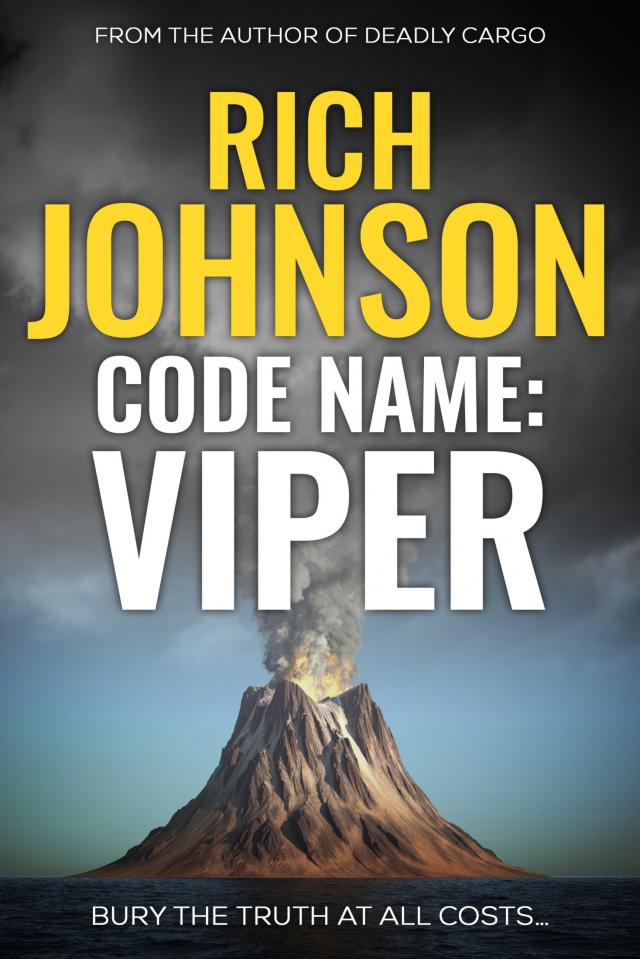
“Xulakan was a forbidden island because, during the time of great destruction, it rose from the sea looking like a smoking pyramid, almost as if it were a fiery, holy temple. From the flatlands of the peninsula, the mountain could be seen on the horizon, belching fire into the sky, thrusting its sharp pinnacles far up into heaven. The Mayan high priests immediately declared Xulakan to be sacred ground, so it was never inhabited, or even visited, by the ancient people.”
“How was the restriction enforced all this time until today?”
“The high priests developed legends and passed them down through the ages. Generation after generation was conditioned by fear, so no one dared desecrate the island.”
“What exactly were they afraid would happen if they went there?”
“According to legend, anyone who trespasses on this forbidden ground will be stricken by a horrible disease. His flesh will erupt with boils that will ooze blood and pus. His tongue will thicken in his throat. He will struggle for breath, but his lungs will be unable to fill. It will be a slow, agonizing suffocation. Even after death, there will be no rest. His bones will be picked clean and scattered by vultures. And his entire family will suffer a similar fate.”
“Whew.”
Dr Menendez paused and looked at me with a serious expression. “In modern times, at the urging of the Mayan ethnic community, legislation was passed and the island was declared by the Mexican government to be a spiritual sanctuary. It is strictly off-limits, under penalty of a long prison sentence.”
“So, the legends of the curse are effective at preventing trespass by the superstitious, and the more immediate threat of a Mexican jail does the trick for everyone else.”
“Perhaps ‘superstitious’ is too strong a word. Let us just say that there are some who still believe in the old ways.”
“Of course,” I agreed. “Sorry.”
He nodded his acceptance of my apology. “Because of all these things, you are the only person who has ever been given permission to visit this restricted site.”
“Well, have you done any fly-overs, to look at the island from the air?” I asked.
“We are not permitted to fly over the island. The spiritual domain of a Mayan pyramid reaches all the way to heaven, and the air space above it is considered sacred. But we have been able to fly past the island at a distance of no closer than five nautical miles. By law, aircraft and boats are restricted, and can come no closer than that.”
“And what did you see from that distance?”
A broad smile crossed his face as he walked to a shelf and reached for something. “Actually, thanks to NASA, we have been able to do a little better than that.” He unrolled a large piece of paper on the coffee table in front of me.
I immediately recognized what it was. “A satellite photo?”
“Yes. It gives us a good overhead view of the island. Between this and the things we have learned from scanning with binoculars from a helicopter, we have drawn a few conclusions. But they are still only speculation until we can put feet on the ground to do a closer survey.”
“So, what have we got here?” I asked, turning the photo so it was oriented with the north arrow at the top.
“The island is large enough that it supports a variety of ecosystems. There is the mountain itself, a wild landscape of reddish black lava that is bare in many places where foliage has never taken root, especially on the pinnacles. Jungle covers much of the island lowland, right down to the beaches.”
“I can see how the pattern changes along here,” I indicated with my finger.
“Yes, the jungle sweeps around where it meets a dry region that stretches along a portion of the south. He pointed, using the tip of his pen. “Through our binoculars, this area appears to resemble much of the arid interior of the Yucatan peninsula.”
“So, the more heavily forested part of the island receives more rain than this arid part?”
“There are times when rain clouds cover the top of the island, and hang there as if they are stuck to the peaks. Even in our dry season, the mountain on Xulakan appears to receive some rain that supports the jungle growth.”
“Judging from what you have seen at a distance, what do you expect me to find?”
“Let us assume a period of a few hundred years for the volcanic mountain to calm down and undergo some erosion and soil build-up. Then another 1,500 years of continued erosion and soil building, accompanied by plant and animal migration. In some respects, the plant infiltration will depend upon animal movement. We have more than three hundred species of birds in the Petenes mangrove region that is the closest land to Xulakan. Many of those birds could have migrated.”
“Taking seeds with them.”
“It is almost without question that some of the birds have transported seeds that they ingested on the Yucatan mainland, and those were deposited through the birds’ excrement. Some of the birds that come to the region are seasonal visitors from great distances, so the plants on Xulakan might have been carried from far away.”
“From mainland Mexico other than the peninsula, then?”
“There and from farther south in Central America, and from the United States and Canada as well.”
“So, we could see quite a variety.”
“Yes, there appears to be a grassland and some colonies of cactus in the dry region. There are palms in great number and many low bushes, but we cannot determine exactly what they are from five miles away. The habitat appears to be quite fertile. And even though there has been no direct interference by people, there is a lot of potential for indirect impact.”
“What do you have in mind?”
“Unfortunately, boats toss garbage overboard, including seeds from fruit.”
“Florida oranges on Xulakan?”
“Who knows?” He shrugged.
“So what about the fauna?”
He went to the wall map and pointed. “Again, the nearest land is the Petenes mangrove region that covers the western coast of the peninsula. There are more than thirty species of mammals and five species of reptiles in the area that could have migrated.”
“Did you see any evidence of that from your fly-by?”
“No. That’s one reason your assignment is so important. We hope you will be able to hike the entire island to document what is there.”
He swept his fingers across the map again. “A hurricane can rip trees loose from the mangrove, here,” he pointed, “and those trees could then be driven by the wind and waves to a distant shore.” He tapped the map where Xulakan stood. “It is not beyond reason to think that such floating debris might carry passengers. The animals on Xulakan could include rodents, small monkeys or even wetland deer.”
“Insects?”
He laughed. “Oh yes, there will be bugs. Flying insects will have found their own way there, and the storms will have carried spiders and others.”