Robots through the ages, p.1
Robots through the Ages, page 1


Subscribe to our newsletter for title recommendations, giveaways, and discounts reserved only for subscribers.
Join here.
BOOKS BY ROBERT SILVERBERG
the new springtime series
At Winter’s End
The Queen of Springtime
the majipoor: lord valentine series
Lord Valentine’s Castle
Majipoor Chronicles
Valentine Pontifex
The Mountains of Majipoor
the majipoor: lord prestimion series
Sorcerers of Majipoor
Lord Prestimion
The King of Dreams
Tales of Majipoor
standalone novels
The Planet Killers
Planet of Death
Time of the Great Freeze
Conquerors from the Darkness
The Gate of Worlds
The Masks of Time
Nightwings
Three Survived
Downward to the Earth
The World Inside
A Time of Changes
Son of Man
The Book of Skulls
Dying Inside
Shadrach in the Furnace
Lord of Darkness
Gilgamesh the King
Sailing to Byzantium
Star of Gypsies
Thebes of the Hundred Gates
Starborne
the legends anthologies
Legends
Legends 2
Legends 3
contributing author
Science Fiction Hall of Fame, Volume 1
omnibus
A Robert Silverberg Omnibus
The Chalice of Death
collections
Space Odyssey (with Arthur C. Clarke and Kurt Vonnegut Jr.)
When the Blue Shift Comes (with Alvaro Zinos-Amaro)
The Best of Robert Silverberg
The Collected Stories of Robert Silverberg
Hunt the Space-Witch!
nonfiction
The Crusades
Scientists and Scoundrels
The Golden Dream
The Mound Builders
Ghost Towns of the American West
The Realm of Prester John
The Pueblo Revolt
The Longest Voyage
Blood on the Mink
Reflections and Refractions
Other Spaces, Other Times
BOOKS BY BRYAN THOMAS SCHMIDT
the saga of davi rhii series
The Worker Prince
The Returning
The Exodus
the john simon thrillers
Simon Says
The Sideman
Common Source
standalone
Shortcut (coming soon)
anthologies as editor
Beyond the Sun
Raygun Chronicles
Shattered Shields (with Jennifer Brozek)
Mission: Tomorrow
Decision Points
Galactic Games
Little Green Men—Attack! (with Robin Wayne Bailey)
Maximum Velocity (with Jennifer Brozek, Carol Hightshoe, David Lee Summers, and Dayton Ward)
Infinite Stars
Monster Hunter Files (with Larry Correia),a #1 bestseller
Predator: If It Bleeds, a #1 bestseller
Joe Ledger: Unstoppable(with Jonathan Maberry)
Joe Ledger: Unbreakable(with Jonathan Maberry)
Infinite Stars: Dark Frontiers
Surviving Tomorrow
Aliens Vs. Predators: Ultimate Prey (with Jonathan Maberry), a #1 bestseller
Predator: Eyes of the Demon, a #1 bestseller
The Hitherto Secret Experiments of Marie Curie (with Henry Herz), a #1 bestseller
nonfiction
How To Write a Novel: The Fundamentals of Fiction
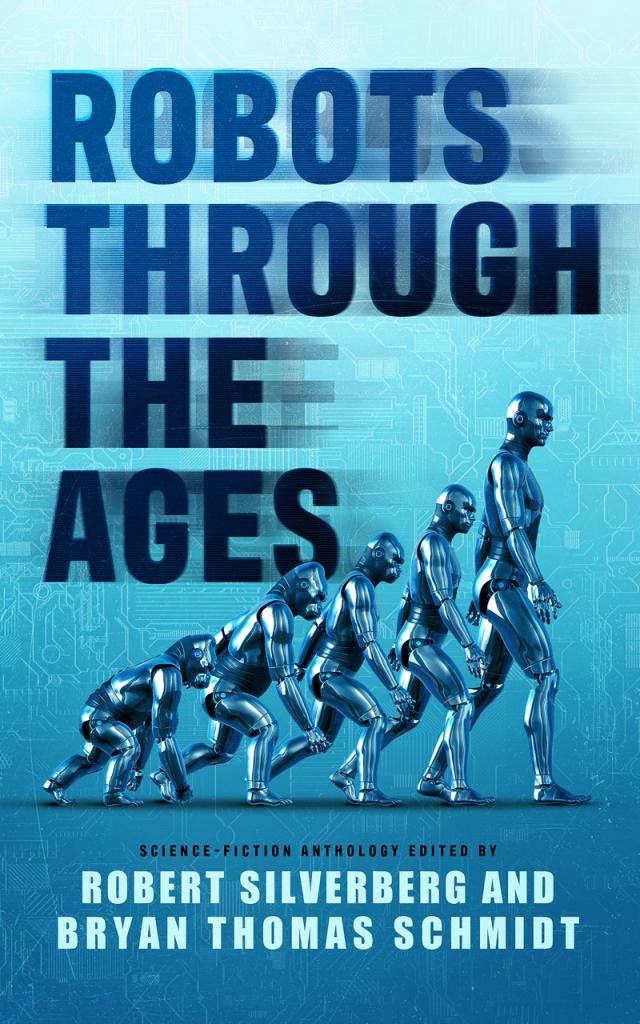
ROBOTS THROUGH THE AGES
A SCIENCE FICTION ANTHOLOGY
EDITED BY
ROBERT SILVERBERG
EDITED BY
BRYAN THOMAS SCHMIDT
CONTENTS
INTRODUCTION
Robert Silverberg
PERFECTION
Seanan McGuire
A NIGHT AT MOXON’S
Ambrose Bierce
WITH FOLDED HANDS
Jack Williamson
Goodnight, Mr. James intro
GOODNIGHT, MR. JAMES
Clifford D. Simak
INSTINCT
Lester del Rey
A BAD DAY FOR SALES
Fritz Leiber
Second Variety intro
SECOND VARIETY
Philip K. Dick
THE GOLEM
Avram Davidson
FOR A BREATH I TARRY
Roger Zelazny
GOOD NEWS FROM THE VATICAN
Robert Silverberg
DILEMMA
Connie Willis
THE ROBOT’S GIRL
Brenda Cooper
THAT MUST BE THEM NOW
Karen Haber
R.U.R.-8?
Suzanne Palmer
ROBINSON CALCULATOR
Paul Levinson
OF HOMEWARD DREAMS AND FALLEN SEEDS AND MELODIES BY MOONLIGHT
Ken Scholes
TODAY I KNOW
Martin L. Shoemaker
AFTERWORD AND RECOMMENDED READING
Acknowledgments
Editor Biographies
Contributor Biographies
Collection © 2023 by Bryan Thomas Schmidt and Agberg Ltd.
Introduction © 2022 Agberg, Inc. Original to this volume. Used by Permission of the Author.
Perfection © 2022 Seanan McGuire. Original to this volume. Used by Permission of the Author.
A Night At Moxon’s. Public Domain. First Published in the San Francisco Examiner on April 16, 1899.
With Folded Hands © 1947, 1948 Jack Williamson. First Published in Astounding Science Fiction, July 1947. Published in A Treasure of Science Fiction edited by Geoff Conklin, Crown Publishers, 1948. Reprinted by Permission of the Estate and its agents, Eleanor Wood and Justin Bell, Spectrum Literary.
Good Night, Mr. James © 1951 Clifford D. Simak. First Published in Galaxy Science Fiction edited by H.L. Gold, March 1951. Reprinted by Permission of the Estate and David W. Wixon.
Instinct © 1952 Lester del Rey. First Published in Astounding Science Fiction edited by John W. Campbell, January 1952. Reprinted by Permission of the Estate and its agent, Vaughne Hansen, The Virginia Kidd Agency.
A Bad Day for Sales. Public Domain. First Published in Galaxy Science Fiction edited by H.L. Gold, July 1953.
Second Variety. Public Domain. First Published in Space Science Fiction, Volume 1, Number 5 (UK) edited by Lester del Rey.
The Golem © 1955 Avram Davidson. First Published in The Magazine of Fantasy and Science Fiction edited by Anthony Boucher, March 1955. Reprinted by Permission of the Estate.
For a Breath I Tarry © 1966 Roger Zelazny. First Published in New Worlds edited by Michael Moorcock, March 1966. Reprinted by Permission of the Estate.
Good News from the Vatican © 1971 Agberg, Inc. First Published in Universe 1 edited by Terry Carr, 1971.
Dilemma © 1989 Connie Willis. First Published in Foundation’s Friends: Stories in Honor of Isaac Asimov edited by Martin H. Greenberg, 1989. Reprinted by permission of the author’s agent, Chris Lotts, Lotts Agency.
The Robot’s Girl © 2010 Brenda Cooper. First Published in Analog Science Fiction and Fact edited by Stanley Schmidt, April 2010. Reprinted by Permission of the Author.
That Must Be Them Now © 2014 Karen Haber. First Published in Unidentified Funny Objects 3 edited by Alex Shvartsman, October 2014. Reprinted by Permission of the Author.
R.U.R.-8? © 2018 Suzanne Palmer. First Published in Asimov’s Science Fiction edited by Sheila Williams, September-October 2018. Reprinted by Permission of the Author.
Robinson Calculator © 2019 Paul Levinson. First Published in the collection Urban Corridors: Fables and Gables. Reprinted by Permission of the Author.
Of Homeward Dreams and Fallen Seeds and Melodies by Moonlight © 2022 Ken Scholes. Original to this volume. Used by Permission of the Author.
Today I Know © 2022 Martin L. Shoemaker. Original to this volume. Used by Permission of the Author.
Afterword & Recommended Reading © 2022 Bryan Thomas Schmidt. Original to this volume. Used by Permission of the Author.
Published in 2023 by Blackstone Publishing
Cover design by Luis Alejandro Cruz Castillo
All rights reserved. This book or any portion thereof may not be reproduced or used in any manner whatsoever without the express written permission of the publisher except for the use of brief quotations in a book review.
The characters and events in this book are fictitious. Any similarity to real persons, living or dead, is coincidental and not intended by the author.
Trade e-book ISBN 978-1-6651-0967-3
Library e-book ISBN 978-1-6651-0966-6
Fiction / Science Fiction / General
Blackstone Publishing
31 Mistletoe Rd.
Ashland, OR 97520
www.BlackstonePublishing.com
From Bob:
For all the science fiction writers and editors of yesteryear I used to know and whom I now miss so greatly as I march on and on into what used to be the future.
From Bryan:
For George Lucas, who first gave me robots to be excited about; the guys at KDR in my
INTRODUCTION
ROBERT SILVERBERG
On a visit to Poland about fifteen years ago I was startled to see, upon emerging from my hotel room, a poster on the wall across the street that was headed with the word ROBOTA in big letters, followed by seven or eight paragraphs in Polish, a language of which I understand about four words.
ROBOTA? “Robots,” was it? Was somebody in Warsaw advertising robots for rent? This was in the early years of the twenty-first century, remember, when the world was not quite as digital as it is now, and robots, to me, were the stuff of science fiction, not commodities to be advertised on wall posters in Poland.
I asked a Polish friend. Sorry, he said. No robots here. “Robota” was simply the Polish word for “job” or “work.” The poster was that of an employment agency looking for clients.
“Robota,” and words similar to it, are found in many Slavic languages, among them Russian, Ukrainian, Bulgarian, Serbian, and Czech. They all are derived from the ancient Slavic word “orbota,” meaning “work,” “hard work,” “obligatory work for the king.” In Czech, “robota” carries the connotation of “drudgery” or even “slave labor.” And it was little more than a hundred years ago, on January 25, 1921, that Prague saw the first performance of a play called R.U.R., by a young and gifted Czech writer named Karel Čapek, that put the word “robot” into the world’s vocabulary. “R.U.R.” stands for “Rossum’s Universal Robots,” in which a scientist named Rossum develops synthetic human beings designed to free us from most of the dreary toil of everyday life, and Čapek’s coinage was destined to enter our languages.
The concept of robots was nothing new, of course. Two and a half millennia ago Greek mythology gave us Talos, a man whom the craftsman-god Hephaestus fashioned out of brass to protect the island of Crete against invaders. The Golem of medieval Jewish legend was an artificial human being. So was the creature that Dr. Frankenstein assembled out of various body parts in Mary Shelley’s novel. I first encountered robots when I was about thirteen in Jack Williamson’s story “With Folded Hands,” in which mechanical men, described as “The Perfect Mechanicals/To Serve and Obey,” not only serve and obey mankind but come completely to dominate it. It is a story that owes more than a little to the theme of the Čapek play, though I have no idea whether Williamson was familiar with it. Another story that I read about the same time was Anthony Boucher’s “Q.U.R.,” which pays open homage to Čapek in its title: the initials here stand for “Quinby’s Usuform Robots.” The Boucher story, first published in 1943, actually foretells today’s robot industry, because its “usuform” robots make no attempt to imitate the human body, but are simply artificial brains in a box with attachments designed to perform the robot’s allotted task. (In this case, a robot bartender.)
But it was Čapek who put the word “robot” into the world’s languages. Or, rather, his brother Josef, who supplied the word to replace Karel’s own inadequate choice. Karel Čapek was born in 1890 in northeastern Bohemia in what is now the Czech Republic, and when he was seventeen moved to the capital city of Prague, where he studied philosophy at Charles University. After further studies in Berlin and Paris he returned to Prague to begin a lifelong career as a journalist. But he took up writing plays as a secondary profession, beginning with The Outlaw in 1920 and following it almost immediately with the play that would bring him worldwide fame, R.U.R., depicting the advent of synthetic human beings that ultimately make the original ones obsolete.
“Rossum” in Czech means “wisdom,” or “reason,” and the most recent English translation of the play rather ungracefully calls the inventor of the robots “Dr. Reason.” (He is simply “Rossum” in the earlier translations.) Čapek thought he might call his artificial humans “Labori,” but the name didn’t seem very forceful to him. He told his older brother Josef, a writer and artist with whom he would maintain a close friendship all his life, that he was thinking of writing a play about the creation of a non-human work force that would spare mankind from unpleasant travail, but needed a good name for his synthetic beings. Josef, who was working on a painting at the time, said, without turning his attention away from his canvas, “Call them robots.” And so it came to pass.
Robots, of course, quickly became part of the apparatus of the developing new field of science fiction, featured in such early stories as Abner J. Gelula’s “Automaton” (1931), Harl Vincent’s “Rex” (1934), and Robert Moore Williams’s “Robots Return” (1938). Isaac Asimov made robots virtually his own property with the series of stories, begun in 1941 and later collected in book form under the title of I, Robot, in which he formulated the famous Three Laws of Robotics that defined a preprogrammed system intended to prevent robots from doing harm to their human overlords. From these early robot stories there quickly emerged a convention that established a distinction between “robots,” mechanical entities of one sort or another, and “androids,” creatures of synthetic flesh nearly or totally indistinguishable from human beings. (This distinction, which nearly all science-fiction writers observed for decades, began to break down in the 1970s when George Lucas called the mechanical men of his Star Wars movie “droids,” short for “androids.”)
Čapek’s pioneering robots were in fact androids in the standard science-fictional sense of that word—synthetic flesh-and-blood beings. We are told in the first act of the play that Rossum’s goal was “reproducing everything exactly as it functions in the human body. Appendix, tonsils, belly-buttons—all completely useless. Even the sexual glands! No need for those if you’re reproducing people artificially!” For Rossum the creation of robots was nothing more than an adventure in pure science, but it was his son who saw that a line of robots designed to perform various kinds of work more efficiently and economically than human beings would have enormous commercial possibilities. The Rossum company proceeded to produce robots—hundreds of them, thousands, hundreds of thousands, flooding the world with them to the point where there was nothing left for humans to do, and the race, given such idleness, gradually withered away, leaving the world entirely to the robots.
It is the fate of most pioneering works to begin to seem quaint as more sophisticated writers revisit their themes. Jack Williamson’s “With Folded Hands” shows us the consequences of surrendering to seemingly benign labor-saving devices. Clifford D. Simak’s classic book City depicts a world in which the humans have vanished and the robots are in charge. And Isaac Asimov’s “The Bicentennial Man” deals with the most poignant aspect of Čapek’s play, the fact that the robots are human in all respects except that they lack souls, some sort of spiritual core, and yearn to have them. When we read R.U.R. today, we may smile indulgently at some of the simplicities of its storytelling—but we must remind ourselves that Čapek, the pioneer, was blazing a trail that generations of science-fiction writers would follow, making new discoveries along the way.
Čapek’s play about robots (which, as noted, were actually androids by science-fictional definition, but that makes no real difference) not only gave the world a useful new word but also was the first to raise serious questions about the relationship between humans and their machines: the robot, which serves and sometimes dominates or even supplants humanity, becomes a metaphor for our entire roster of ingenious and perhaps dangerous labor-saving devices. His robots are something more than clever computers with legs: they are almost human, human in all but birth, second-class citizens called forth by scientific means to serve as slaves. The entire question of the moral standing of slavery can be looked at in a new light, thanks to Čapek: Do we have the right to enslave creatures of flesh and blood, even though we have manufactured them merely to serve us?